Do Dogs Have Belly Buttons?
Do Dogs Have Belly Buttons? Yes — every dog is born attached to its mother by an umbilical cord, and when that cord is gone, it leaves a small scar behind — just like a person’s belly button.
The reason most owners have never noticed one is simple: a dog’s belly button looks nothing like a human one. It is tiny, flat, and usually hidden under fur, so it is easy to rub a dog’s belly for years without ever spotting it.
This guide explains where to find your dog’s belly button, how puppies get one, and how to tell a normal belly button from a lump that needs a vet.
In this guide
- Where is a dog’s belly button?
- Why are dog belly buttons so hard to see?
- How do puppies get a belly button?
- Belly button or umbilical hernia: how to tell the difference
- Do cats and other animals have belly buttons?
- Frequently asked questions
Where Is a Dog’s Belly Button?
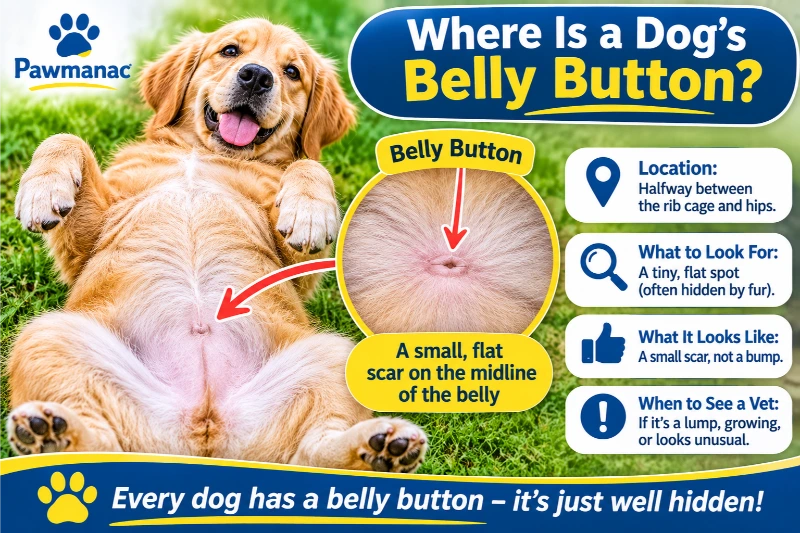
A dog’s belly button sits on the midline of the belly — the centre line running down the underside — roughly halfway between the bottom of the rib cage and the hips. On most dogs it feels like a small, flat, slightly raised or wrinkled patch of skin, sometimes with a little swirl of fur growing around it.
The easiest time to look is when your dog is relaxed on its back or side during a belly rub. Part the fur along the centre of the belly and look for a small oval or vertical scar, usually no bigger than a fingernail. On thick or long coats, you may only be able to feel it as a tiny flat bump rather than see it — and on some dogs the scar fades so completely that even vets have to look carefully.
Why Are Dog Belly Buttons So Hard to See?
Humans make belly buttons obvious. Ours are cut, clamped and tied at birth, and the leftover stump heals into a clear innie or outie on bare skin. A dog’s version is much less dramatic, for three reasons:
- It is small. The cord on a puppy is thin, so the scar it leaves is small too.
- It heals flat. Dogs do not get innies or outies. The scar normally heals level with the skin, so there is no dent or nub to catch your eye.
- Fur covers it. Most dogs have a layer of hair over the belly, and the scar hides underneath it.
So a dog’s belly button is less like a button and more like a faint seam — present on every dog, but designed by nature to disappear.
How Do Puppies Get a Belly Button?
Before birth, the umbilical cord connects each puppy to a placenta, which delivers oxygen and nutrients from the mother. Puppies do not breathe or eat on their own until they are born, so the cord is their lifeline.
When a puppy is born, the mother usually chews through the umbilical cord herself, close to the puppy’s belly. (When a breeder or vet helps, they may clamp and cut it instead.) A short stump of cord is left attached to the puppy. Over the next few days that stump dries out, shrivels, and falls off on its own. The small scar left behind is the belly button.
Newborn puppies are completely helpless for their first weeks — they cannot see, hear well, or even go to the toilet without their mother licking them to stimulate it. The mother also keeps the nest clean by eating the puppies’ waste, which is one of the natural roots of why dogs eat their own poop later in life. And when they are not feeding, newborn puppies spend almost all their time asleep — if that surprises you, see our guide to why dogs sleep so much.
One caution: never pull at a puppy’s cord stump or try to tidy it up. It falls off by itself, and pulling it can cause bleeding or infection. If a stump looks swollen, wet, smelly, or is still attached after about a week, a vet should check it.
Belly Button or Umbilical Hernia: How to Tell the Difference
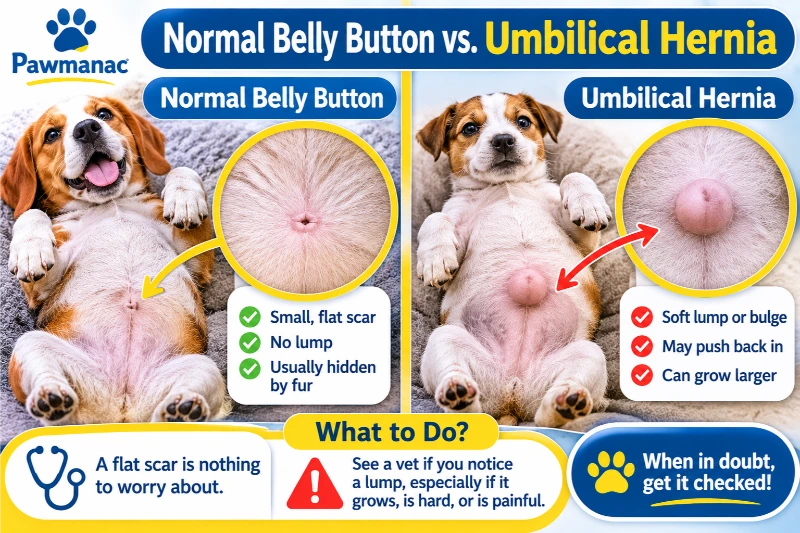
This is the one part of the topic that actually matters for your dog’s health. Sometimes what looks like a belly button is an umbilical hernia — a small opening in the abdominal wall where the cord was attached, which did not close fully after birth. A bit of fat (and occasionally intestine) can push through the opening and form a soft bulge under the skin.
A normal belly button is flat. A hernia sticks out. Use this table as a guide:
| Normal belly button | Possible umbilical hernia | |
|---|---|---|
| Looks like | A small, flat scar or faint wrinkle in the skin | A round lump or bulge on the midline of the belly |
| Feels like | Flat skin, nothing underneath it | A soft lump that may gently push back in when pressed |
| Size | Fingernail-sized, never grows | Pea-sized to golf-ball-sized, can grow as the puppy grows |
| What to do | Nothing — it is just a scar | Have your vet check it, especially in a puppy |
Many small umbilical hernias in puppies close on their own by about six months of age, and vets often simply monitor them or repair them during spaying or neutering. But a hernia should always be a vet’s call, not a guess at home.
See a vet promptly if a belly lump:
- Is growing, hard, or cannot be gently pushed back in
- Feels hot, looks red or discoloured, or seems painful when touched
- Comes with vomiting, loss of appetite, crying, or a swollen, tense belly
Those signs can mean tissue is trapped in the hernia, which is an emergency.
Do Cats and Other Animals Have Belly Buttons?
Yes. Every placental mammal — dogs, cats, horses, cows, and people — is nourished through an umbilical cord before birth, so every one of them has a belly button scar.
A cat’s belly button is even harder to find than a dog’s: a tiny flat scar on the midline of the belly, buried under fur. Most cat owners never see it, and that is normal.
Animals that lay eggs, like birds and reptiles, do not have belly buttons, and marsupials are different again — a joey is born tiny and finishes developing in the pouch. But if an animal was fed through a cord before birth, it carries the mark.
While you are in curiosity mode, here is another common dog question with a surprising answer: dogs do not see in black and white. Our guide to what colors dogs see explains what the world actually looks like to your dog.
Frequently Asked Questions
The Bottom Line
Dogs have belly buttons — every single one of them. It is the small, flat scar left behind when the umbilical cord stump falls off a few days after birth, and it sits on the midline of the belly, hidden under fur. Dogs do not have innies or outies, so if you find a lump instead of a flat scar, that is not a belly button at all: it may be an umbilical hernia, and your vet should take a look.
This article is for general information. It is not a substitute for advice from your veterinarian.
Sources
- American Kennel Club: dog and puppy care guides (akc.org)
- VCA Animal Hospitals: umbilical hernia in dogs (vcahospitals.com)