
What Colors Do Dogs See? A Complete Guide to Your Dog’s Vision
Have you ever wondered what the world looks like through your dog’s eyes? You might throw a bright red ball across a green lawn, expecting your dog to spot it immediately, but sometimes your furry friend seems to have trouble finding it. Is it possible that your dog sees colors differently from you?
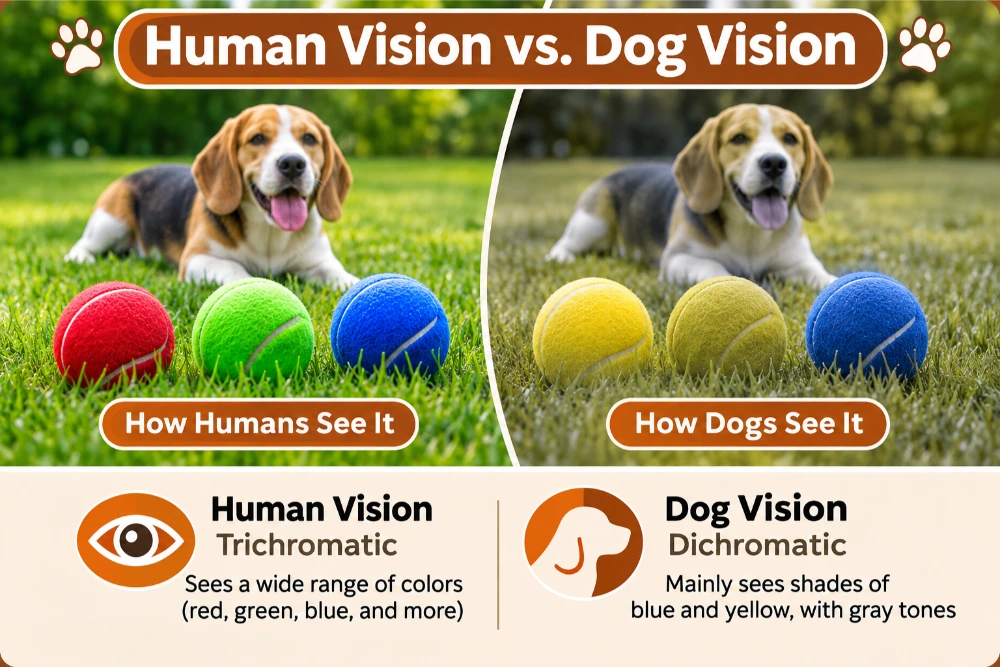
The answer is yes! Dogs can see colors, but their vision works differently from human vision. While people can distinguish a wide range of colors, dogs mainly see shades of blue and yellow. Colors such as red and green are much harder for them to distinguish and may appear as muted shades of brown, gray, or yellow.
This doesn’t mean dogs see the world in black and white. They experience a different color spectrum because their eyes contain fewer types of color-detecting cells than human eyes. They also have visual abilities that help them detect movement and see in dim lighting.
Understanding what colors dogs see can help you choose better toys, make playtime more enjoyable, and understand how your pet experiences its surroundings. In this guide, we’ll explain how dog color vision works, which colors they can recognize, how their eyesight compares with ours, and what these differences mean in everyday life.
Quick Answer: What Colors Do Dogs See?
Dogs primarily see shades of blue and yellow, along with different shades of gray. They have dichromatic vision, meaning their eyes contain two types of color-detecting cone cells, compared with three types in most humans.
Dogs can distinguish many blue and yellow shades, but they have difficulty telling red and green apart. These colors may appear as muted brownish, yellowish, or grayish shades rather than the bright colors people see.
Here’s a simple comparison:
| Color | How Dogs May Perceive It |
| Blue | Blue |
| Yellow | Yellow |
| Violet | Blue-like shades |
| Red | Dark brownish or grayish shades |
| Orange | Yellowish or brownish shades |
| Green | Muted yellowish or grayish shades |
| Pink | Muted or grayish shades |
| Purple | Blue-like shades |
| White | White or light gray |
| Black | Black or very dark gray |
These are simplified descriptions rather than exact color conversions. The appearance of an object also depends on its brightness, lighting, surrounding colors, and contrast.
Can Dogs See Color or Are They Completely Colorblind?
Dogs can see color, so the common belief that they only see in black and white is incorrect.
However, their color perception is more limited than ours. Dogs have what’s called dichromatic vision, which means they use two types of cone photoreceptors to detect color.
Humans typically have three types of cones, allowing us to distinguish combinations of red, green, and blue wavelengths. Dogs lack the third type of cone responsible for normal red-green color discrimination.
As a result, dogs experience a color spectrum that is more similar to that of a person with red-green color vision deficiency.
This doesn’t mean dogs see everything in grayscale. They can recognize blue and yellow shades and distinguish certain differences in brightness and contrast.
Scientists established this through research examining how dogs respond to different wavelengths of light and how their visual systems process color information.
A landmark 1989 study by researchers Jay Neitz, Timothy Geist, and Gerald Jacobs found that dogs have two classes of cone photopigments, confirming that their color vision is dichromatic.
What Colors Can Dogs See Best?
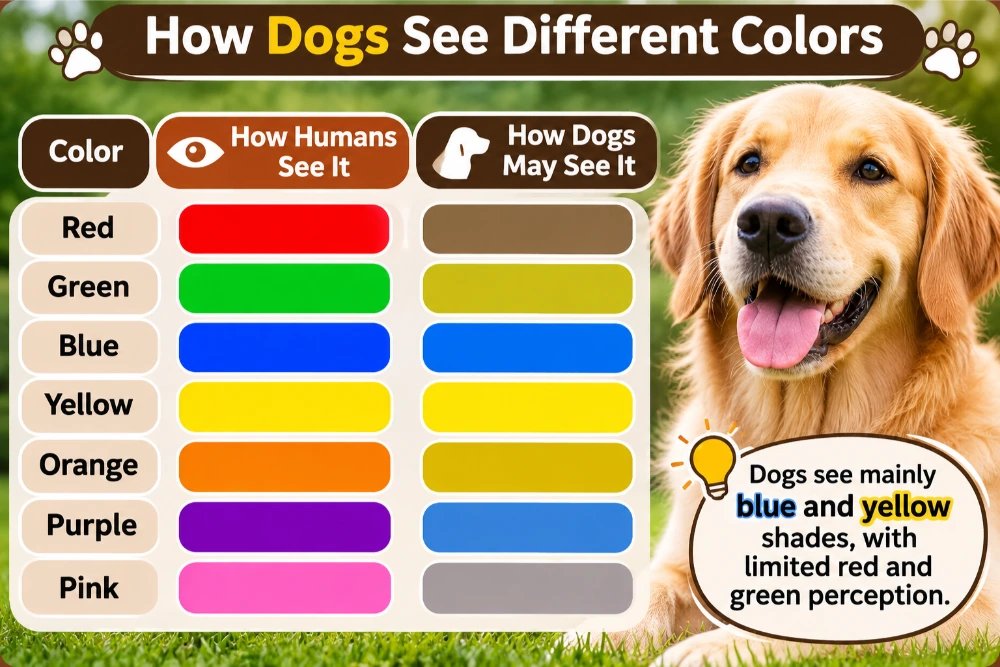
Although dogs cannot distinguish the same range of colors as humans, they can recognize several shades within their visual spectrum.
Blue and yellow are generally the easiest colors for dogs to distinguish.
Understanding how individual colors appear to your pet can help you make better choices when buying toys, selecting training equipment, or planning outdoor activities.
Can Dogs See Blue?
Yes! Blue is one of the colors dogs can see particularly well.
Their eyes contain cone cells that respond to shorter wavelengths of light, which help them recognize blue shades. They can distinguish different blue tones, although the exact level of detail may vary.
This makes blue toys a useful choice, especially when your dog plays outside on green grass.
For example, a blue tennis ball or frisbee may stand out more clearly against a grassy background than a red or green toy.
If your dog regularly loses toys outdoors, trying a blue one may make playtime easier.
Can Dogs See Yellow?
Yes, dogs can also recognize yellow.
Their second type of cone photoreceptor responds to longer wavelengths associated with yellowish colors. This allows them to distinguish yellow from many other shades within their limited color spectrum.
Yellow toys, training equipment, and accessories can be useful choices depending on the surrounding environment.
For example, a yellow toy may stand out against a darker floor or background.
However, yellow objects may be harder to distinguish when placed against similarly colored grass or surfaces. Contrast is just as important as the toy’s color.
Can Dogs See Red?
Dogs cannot distinguish red in the same way humans can.
A bright red ball that looks highly noticeable to you may appear much darker or more muted to your dog. Depending on the lighting and surrounding objects, it may look brownish or grayish.
This is one reason a red toy can sometimes be difficult for dogs to locate in green grass.
Your dog may still find a red toy using movement, smell, and other visual cues, but its color alone may not make it easy to recognize.
Can Dogs See Green?
Dogs have difficulty distinguishing green because they lack the same red-green color receptors that humans use.
Green objects may appear as muted yellowish or grayish shades rather than the bright green people recognize.
Imagine placing a green tennis ball on a grassy lawn. Because the ball and the grass may look relatively similar to your dog, finding the toy can become more challenging.
If you want to make outdoor games easier, choose toys that create stronger visual contrast with their surroundings.
Can Dogs See Orange?
Orange is another color dogs don’t perceive the same way humans do.
An orange ball may appear more yellowish or brownish, depending on its shade and lighting conditions.
Although your dog can still recognize the object, its color may not provide the same visual distinction that you experience.
For outdoor play, consider choosing a blue toy instead of relying on orange or red accessories.
Can Dogs See Purple and Violet?
Dogs can perceive certain shades of violet, but they may see them as blue-like colors.
This happens because their color vision is based on two cone types rather than the three types found in typical human vision.
A purple toy may therefore look quite different to your dog than it does to you.
Can Dogs See Pink?
Pink is not a color dogs can distinguish as clearly as humans.
Depending on the shade, a pink object may appear muted, grayish, or similar to another color within their limited visual spectrum.
A pink toy might look bright and attractive to its owner but may not be especially noticeable to a dog.
If visibility is important, consider choosing a blue or yellow toy with strong contrast against its surroundings.
Why Do Dogs See Fewer Colors Than Humans?

The main reason dogs see fewer colors is the difference in their retinal structure.
The retina is a light-sensitive layer at the back of the eye. It contains specialized cells called photoreceptors, which help the brain interpret visual information.
Two important types of photoreceptors are rods and cones.
What Are Cone Cells?
Cone cells are responsible for color vision and help the eyes recognize details in brighter lighting.
Most humans have three types of cone cells:
- Red-sensitive cones.
- Green-sensitive cones.
- Blue-sensitive cones.
These three types work together to create the wide range of colors we experience.
Dogs, however, have only two main types of color-detecting cones. They are particularly sensitive to blue and yellow wavelengths.
Because dogs lack the cone type needed for normal red-green color discrimination, they cannot recognize the same variety of colors as humans.
What Are Rod Cells?
Rod cells help the eyes detect light intensity and movement, especially in dim lighting.
Dogs have a rod-dominant visual system, which gives them advantages when detecting movement and navigating low-light environments.
While cones are important for color perception, rods help dogs notice changes in their surroundings, even when lighting conditions are not ideal.
This difference helps explain why dogs may struggle to distinguish a red toy from green grass but still notice a small object moving across the lawn.
Dog Vision vs. Human Vision: What’s the Difference?
Dogs and humans experience the same surroundings in different ways.
Humans generally have stronger color discrimination and sharper visual detail in daylight, while dogs have certain advantages in motion detection and low-light vision.
Here’s how their eyesight compares:
| Vision Feature | Humans | Dogs |
| Color vision | Trichromatic | Dichromatic |
| Types of cones | Three | Two |
| Main color range | Broad range of colors | Mainly blue and yellow |
| Red-green distinction | Usually strong | Limited |
| Motion detection | Good | Generally more sensitive |
| Low-light vision | More limited | Generally better |
| Visual sharpness | Usually clearer | Generally less sharp |
| Night vision | Limited | Better in dim light |
Do Dogs Have Blurry Vision?
Dogs generally have lower visual acuity than humans.
Visual acuity describes how clearly someone can see objects and distinguish fine details.
Many dogs are estimated to have approximately 20/75 vision. This means an object a person with typical 20/20 vision can recognize from 75 feet away may need to be around 20 feet away for a dog to see with comparable clarity.
However, this is a general estimate rather than a measurement that applies equally to every dog.
Breed, eye structure, and individual differences can affect visual performance.
Can Dogs See Better in the Dark?
Dogs generally see better than humans in low-light conditions.
Their eyes contain more rod photoreceptors, which are sensitive to lower levels of light. They also have a reflective structure called the tapetum lucidum behind the retina.
This structure reflects light back through the retina, giving photoreceptors another opportunity to detect it.
It’s also responsible for the glowing appearance you sometimes notice in your dog’s eyes when light shines toward them at night.
However, better low-light vision doesn’t mean dogs can see in complete darkness. They still need some available light to detect their surroundings.
Are Dogs Better at Detecting Movement?
Dogs are generally very good at detecting movement.
Their visual system is particularly useful for noticing moving objects, which can help them follow toys, observe other animals, and respond to activity around them.
For example, your dog might notice a moving ball from a distance even when its color isn’t particularly easy to distinguish.
This is why movement, contrast, and shape are often more important than color alone when dogs identify objects.
How Does Dog Vision Affect Their Everyday Life?
A dog’s limited color perception doesn’t prevent it from enjoying normal activities. Dogs use a combination of vision, hearing, smell, and other sensory information to understand their surroundings.
However, understanding their eyesight can help owners make everyday experiences more comfortable.
Choosing the Right Dog Toys
One of the easiest ways to apply this information is when selecting toys.
Many dog toys come in bright red, orange, pink, and green colors because they look attractive to humans. But those colors may not be the easiest for dogs to distinguish.
Consider choosing:
- Blue balls for outdoor fetch.
- Blue frisbees for open grassy areas.
- Yellow toys for darker indoor surfaces.
- Toys with different textures for additional sensory stimulation.
- Toys that make sounds to help dogs locate them.
The goal isn’t to buy every toy in blue or yellow. It’s to choose toys that are easy to locate within their surroundings.
Making Fetch Games Easier
If your dog struggles to find a ball after you throw it, the color might be one reason.
A red ball on green grass may not provide enough visual contrast for a dog with dichromatic vision.
Try using a blue ball and throwing it into an open area where it is easy to spot.
You can also use toys that bounce, move unpredictably, or produce sounds.
Remember that your dog may rely on its nose to locate a toy after it lands, so don’t assume that every missed ball is caused by color perception.
Training With Visual Signals
Dogs can learn to respond to hand signals and visual cues during training.
However, the effectiveness of a visual cue doesn’t depend entirely on its color.
The size, position, movement, and contrast of the signal can all influence how easily your dog notices it.
If you’re teaching your dog a new command, use clear gestures and consistent movements. Avoid relying on small colored objects that blend into the background.
Making Outdoor Activities More Enjoyable
Outdoor activities provide opportunities for exercise, exploration, and mental stimulation.
When taking your dog outdoors, choosing comfortable walking equipment is also important. A properly fitted harness can make everyday walks and outdoor activities more comfortable for your pet.
When choosing equipment for outdoor activities, consider how visible it will be to your dog.
A blue toy may be easier to distinguish against green grass, while a yellow toy could work better against a darker surface.
You can also introduce toys with different textures and sounds to provide additional ways for your dog to locate them.
How Do Scientists Know What Colors Dogs Can See?
Scientists didn’t simply guess that dogs see blue and yellow. Their understanding comes from examining canine eye anatomy and conducting behavioral experiments.
Researchers study the types of cone photoreceptors in the retina and how they respond to different wavelengths of light.
They also observe whether dogs can distinguish between colored objects when other visual cues are controlled.
Studying Cone Photoreceptors
One way scientists understand color vision is by examining the photoreceptors inside the retina.
The different cone types respond to particular wavelengths of light.
Studies of canine retinas have identified two types of cone photopigments, supporting the conclusion that dogs have dichromatic vision.
Behavioral Experiments
Researchers can also train dogs to recognize particular colors by associating them with rewards.
For example, a dog may be trained to select one colored object rather than another. Scientists can then change the brightness or other characteristics to determine whether the animal is responding to color or simply choosing the brighter object.
This type of research helps distinguish genuine color perception from differences in light intensity.
The 1989 study by Neitz, Geist, and Jacobs is an important example of research that established the scientific understanding of canine color vision.
Do All Dog Breeds See Colors the Same Way?
Most healthy dogs share the same basic type of color vision because the underlying cone structure is broadly similar across domestic dogs.
However, their overall visual experience can vary.
Differences in eye placement, head shape, retinal structure, and other anatomical characteristics may influence how dogs perceive their surroundings.
For example, breeds with long, narrow heads may have different fields of view from breeds with shorter, flatter faces.
Some breeds may also be more prone to inherited eye conditions that affect their vision.
It’s important to distinguish between normal differences in canine color perception and an actual eye health problem.
If your dog suddenly starts bumping into objects, hesitating in familiar surroundings, or struggling to find things it previously recognized, arrange a veterinary examination.
How Can You Test Whether Your Dog Recognizes Different Colors?
You can try a simple observation activity at home to understand how your dog responds to different colored objects.
This isn’t a scientific eye examination, but it can be an enjoyable way to explore your pet’s visual preferences.
Step 1: Choose Different Colored Toys
Find several toys that look different in color, such as blue, yellow, red, and green.
Try to select objects with similar sizes and shapes so that other visual differences don’t influence the activity too much.
Step 2: Use a Neutral Background
Place the toys on a surface that doesn’t closely match their colors.
A neutral background can make it easier to observe whether your dog notices each object.
Step 3: Let Your Dog Explore
Place the toys a short distance away and encourage your dog to investigate them.
Notice which objects attract its attention and whether it has difficulty finding particular toys.
Step 4: Change Their Positions
Move the toys around and repeat the activity.
This helps you observe whether your dog is responding to the objects themselves or simply remembering where they were placed.
Step 5: Avoid Drawing Scientific Conclusions
A dog choosing one toy over another doesn’t necessarily prove that it can see that color better.
Dogs may prefer certain textures, smells, shapes, or familiar objects.
For accurate assessment of visual health, consult a veterinarian rather than relying on a home activity.
Common Myths About Dog Vision
There are several misconceptions about how dogs see the world. Understanding the facts can help owners make better decisions about their pets.
Myth 1: Dogs Only See in Black and White
Fact: Dogs can see colors, particularly blue and yellow. Their color range is simply more limited than that of humans.
Myth 2: Dogs Cannot Recognize Any Bright Colors
Fact: Dogs can distinguish certain colors and shades. Blue and yellow are especially useful within their visual spectrum.
Myth 3: Dogs Have Poor Eyesight in Every Situation
Fact: Although dogs generally have less visual sharpness than humans, they have advantages in detecting movement and seeing in dim lighting.
Myth 4: Red Toys Are Always Invisible to Dogs
Fact: Dogs can still detect red objects through brightness, contrast, movement, and other visual information. They simply cannot distinguish red as humans normally do.
Myth 5: Every Dog Sees Exactly the Same Way
Fact: Dogs share a similar basic color vision system, but individual differences, breed characteristics, age, and eye health can influence overall vision.
Frequently Asked Questions:
The Bottom Line:
Dogs don’t experience the world through the same range of colors that humans do. Their eyes are designed for dichromatic vision, which means they primarily distinguish blue and yellow shades rather than the full spectrum of colors people enjoy.
They may struggle to recognize red, green, orange, and pink as clearly as humans, but that doesn’t mean their world is black and white. Their vision also includes useful abilities such as detecting movement and seeing in dim lighting.
As a dog owner, you can use this knowledge to make small but helpful changes. Choose toys that stand out against their surroundings, use clear visual signals during training, and consider your pet’s visual abilities when planning games.
Most importantly, remember that dogs experience the world through more than their eyes. Their powerful sense of smell, sensitive hearing, and ability to recognize movement all help them understand and enjoy their surroundings.






2 Comments