Best Cat Tree for Large Cats: 7 Sturdy Options and Buying Tips
Finding the best cat tree for large cats can be challenging, especially if you share your home with a Maine Coon, Ragdoll, Norwegian Forest Cat, or another big feline. Many standard cat trees are designed for average-sized cats, which means their platforms, scratching posts, and sleeping areas may feel too small for heavier or longer-bodied pets.
A large cat needs more than a tall tower. It needs a stable structure that can support its weight, spacious platforms for comfortable resting, strong scratching posts, and enough room to climb without feeling cramped. A poorly designed cat tree may wobble when your cat jumps onto it, discourage regular use, or even create a tipping hazard.
The good news is that several manufacturers now offer extra-large cat trees, heavy-duty cat condos, and reinforced climbing furniture designed for bigger breeds. Some provide multiple sleeping areas for multi-cat households, while others focus on solid wood construction, oversized perches, or space-saving designs.
In this guide, we’ll explore some of the best cat trees for large cats, compare their features, explain what makes a tower suitable for heavier pets, and share practical buying tips to help you choose the right option for your home.
Quick Answer: What Is the Best Cat Tree for Large Cats?
The best cat tree for large cats is one that combines a wide, stable base, spacious platforms, sturdy construction, and scratching posts strong enough for daily use. The PAWZ Road 72-inch Cat Tree is one option worth considering because it offers multiple resting areas, large cat houses, and a hammock. For cats that prefer lower furniture, the Prestige 46-inch Heavy Duty Cat Tree is another option with three spacious beds.
Other options include the New Cat Condos Deluxe Cat Tower for cats that enjoy comfortable resting areas, the Sopapets 65-inch Cat Tree for owners looking for a premium design, and the Globlazer 50-inch Heavy-Duty Cat Tree for homes with limited vertical space.
Before purchasing, check the actual platform dimensions and manufacturer weight limits. A product described as extra-large isn’t automatically suitable for every large cat.
7 Best Cat Trees for Large Cats
Not every large cat has the same needs. Some enjoy climbing to the highest available platform, while others prefer spacious beds, enclosed condos, or low-level resting areas.
The following options offer different layouts and features to consider when shopping for a large cat tree.
PAWZ Road 72-Inch Cat Tree – Best Overall Option
The PAWZ Road 72-inch Cat Tree is a popular option for households with larger cats because it combines several climbing, scratching, and resting areas in one structure. Its tall design gives active cats opportunities to explore different levels, while its hammock and enclosed houses provide alternative places to relax.
One feature that makes this model interesting is its combination of open and enclosed resting spaces. Some cats prefer sleeping in a covered condo, while others enjoy stretching out in an open hammock or bed.
The Cats.com review reports that the reviewer tested this model with cats of different sizes, including a 20-pound cat. The reviewer also noted that the tree remained stable during testing but recommended using the included wall safety strap.
Key features:
- Approximately 72 inches tall.
- Multiple platforms and scratching posts.
- Two enclosed cat houses.
- A central hammock.
- Removable bed covers on selected resting areas.
- Wall-anchoring strap for additional stability.
Best for: Large cats that enjoy climbing, scratching, and having several resting locations.
One consideration is that not every platform will necessarily feel spacious enough for every large cat. Check the dimensions before buying, particularly if your cat is especially long or heavy.
Prestige 46-Inch Heavy Duty Cat Tree – Best for Spacious Resting Areas
Not every large cat enjoys climbing a tall tower. Older cats, less active pets, and cats with mobility limitations may prefer furniture with lower resting areas and easier access.
The Prestige 46-inch Heavy Duty Cat Tree offers a shorter design with a wide base and three large cat beds. Its layout provides several comfortable resting locations without requiring cats to climb through multiple high levels.
According to the Cats.com review, the model includes three 18.5-inch beds and scratching surfaces covered with carpet and sisal. The reviewer found assembly relatively simple and reported that the cats used the different resting areas regularly.
Key features:
- Approximately 46 inches tall.
- Three 18.5-inch cat beds.
- Wide and sturdy base.
- Carpet and sisal scratching surfaces.
- Relatively simple assembly.
Best for: Large cats that prefer lounging, senior cats that can comfortably access its levels, and households that don’t need a very tall tower.
One potential drawback is carpet shedding, which the reviewer noticed during testing. You may need to vacuum around the furniture regularly.
Sopapets 65-Inch Cat Tree – Best Premium Option
If you’re willing to spend more on cat furniture, the Sopapets 65-inch Cat Tree is worth exploring. It offers a larger structure with multiple resting areas and sisal scratching surfaces.
Its construction and overall weight are important considerations when choosing furniture for large cats. A heavier base can help improve stability, although the complete structure still needs appropriate positioning and anchoring.
The Cats.com reviewer described this model as well-crafted and noted that its heavier individual components and base contributed to a sturdy feel during testing.
Key features:
- Approximately 65 inches tall.
- Multiple resting areas.
- Large hammock-style sleeping spaces.
- Sisal-wrapped scratching posts.
- Heavy construction and base.
Best for: Owners looking for a premium cat tree with multiple resting and scratching areas.
The main disadvantage is its higher price compared with many standard cat trees. Consider whether your cat will use the additional features before making the investment.
New Cat Condos Deluxe Cat Tower – Best for Cats That Love Napping
Some cats spend more time sleeping than climbing. If your pet prefers comfortable resting spots, a cat condo with several spacious beds may be more useful than a tall playground filled with small platforms.
The New Cat Condos Deluxe Cat Tower is designed around multiple resting and scratching areas. The Cats.com review highlights its three 17-inch cat beds and several tall scratching posts.
Its construction is another reason to consider it. New Cat Condos offers products made with materials such as solid wood, household-grade carpet, and natural sisal rope.
Key features:
- Three approximately 17-inch cat beds.
- Multiple scratching posts.
- Sturdy construction.
- Comfortable carpeted surfaces.
- Several resting locations.
Best for: Large cats that enjoy sleeping in different locations throughout the day.
The reviewer reported that the carpet shed and one scratching surface showed damage after an initial period of use. These are worth considering when evaluating long-term maintenance.
Globlazer 51-Inch Corner Cat Tree – Best for Small Spaces
A large cat tree doesn’t always need to occupy a significant amount of floor space. If you live in an apartment or have limited room, a corner design may offer a practical alternative.
The Globlazer Corner Cat Tree is designed to fit into a corner while providing several levels for climbing and resting. Its layout includes a top bed, an enclosed house, and scratching surfaces.
The Cats.com review notes that the model provides useful resting areas for large cats, although some of its smaller features may be more suitable for medium-sized pets.
Key features:
- Approximately 51 inches tall.
- Corner-friendly design.
- Top resting bed.
- Enclosed cat house.
- Multiple scratching posts.
- Different levels for climbing and relaxing.
Best for: Owners who need a space-saving design without giving up vertical activity areas.
If your cat is particularly large, check the size of the hammock and enclosed sections before purchasing. The reviewer also mentioned that not every feature was equally suitable for bigger cats.
Frisco 65-Inch XXL Heavy Duty Cat Tree – Best Multi-Level Alternative
The Frisco 65-inch XXL Heavy Duty Cat Tree is another option to compare when shopping for large-cat furniture. It offers a multi-level design with an enclosed condo and spacious resting areas.
Its structure is intended to provide opportunities for climbing, scratching, and relaxing without relying on a single small platform.
Key features:
- Approximately 65 inches tall.
- XXL heavy-duty design.
- Enclosed resting condo.
- Multiple landing and lounging areas.
- Multi-level climbing structure.
Best for: Owners looking for a traditional multi-level cat tree with an extra-large design.
Before purchasing, check the dimensions of each platform and the manufacturer’s weight guidance. The XXL label alone doesn’t establish that every level can comfortably accommodate a particularly heavy cat.
New Cat Condos Solid Wood Climbing Tower – Best Solid Wood Option
For owners who prioritize construction materials, New Cat Condos offers solid wood climbing furniture designed for cats that need sturdy resting and scratching areas.
Its solid wood climbing tower available through Petco features multiple levels and natural sisal scratching surfaces. The brand also offers other large-cat designs with spacious platforms and reinforced bases.
Solid wood can be a useful feature when comparing cat furniture, but the quality of the joints, base, fasteners, and overall design matters just as much.
Key features:
- Solid wood construction.
- Natural sisal scratching surfaces.
- Multiple climbing and resting levels.
- Carpeted surfaces.
- Design options for different room layouts.
Best for: Owners who prefer solid wood furniture and want to explore more durable construction options.
Check the specific model’s dimensions and weight guidance because New Cat Condos offers several different designs, and their features are not identical.
Comparison of the Best Cat Trees for Large Cats
Here is a quick comparison to help narrow down your choices.
| Cat Tree | Approx. Height | Main Advantage | Best For |
| PAWZ Road | 72 inches | Multiple features | Active large cats |
| Prestige Heavy Duty | 46 inches | Three spacious beds | Lounging cats |
| Sopapets | 65 inches | Premium construction | Premium buyers |
| New Cat Condos Deluxe | Varies by model | Multiple resting areas | Cats that love sleeping |
| Globlazer Corner | 51 inches | Corner-friendly design | Smaller rooms |
| Frisco XXL | 65 inches | Multi-level layout | Climbing and resting |
| New Cat Condos Solid Wood | Varies by model | Solid wood construction | Durability-focused buyers |
Product specifications can vary between versions and retailers. Always confirm the exact dimensions, weight limits, and included safety hardware for the model you’re considering.
What Makes a Cat Tree Suitable for Large Cats?
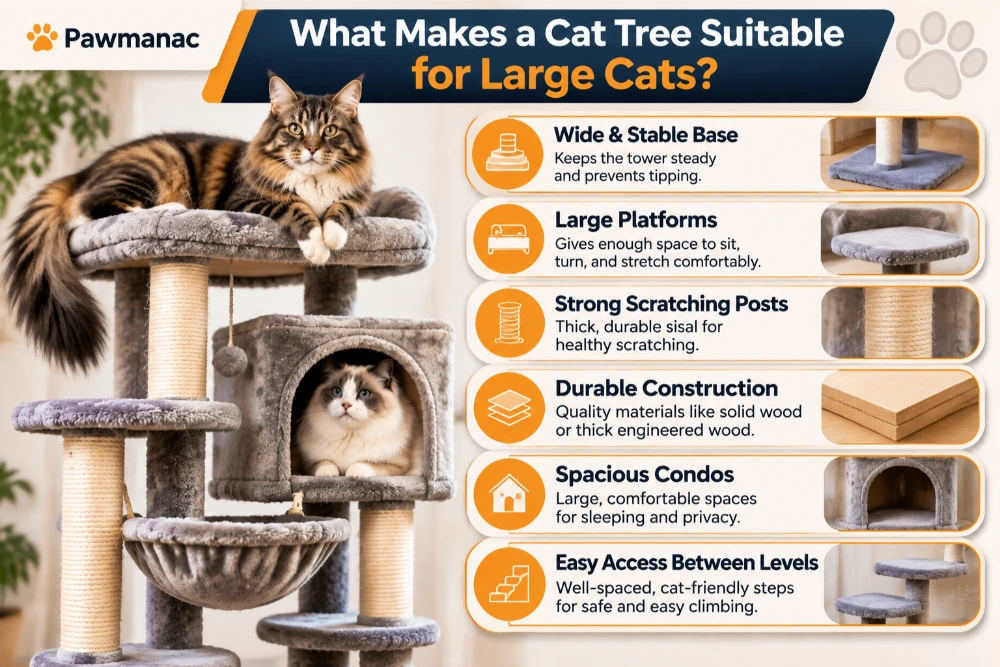
A cat tree designed for a large breed should offer more than additional height. Its structure needs to accommodate a heavier body, stronger jumps, larger paws, and more space for resting.
Here are the most important features to evaluate.
Wide and Stable Base
The base is one of the most important parts of a cat tree. It supports the entire structure and helps prevent the tower from tipping when your cat climbs or jumps.
Large cats can place considerable force on a structure when landing on an elevated platform. A narrow or lightweight base may cause the tower to move, particularly if the cat lands near one edge.
Look for:
- A wide base with a balanced footprint.
- Heavy and sturdy base materials.
- Secure connections between the base and vertical posts.
- A design that doesn’t rock during normal use.
For taller towers, use the manufacturer’s recommended wall-anchoring hardware. Attach it to an appropriate structural point, such as a wall stud, using suitable hardware.
Large and Comfortable Platforms
Platform size matters just as much as overall height. A cat tree may look impressive in product photographs, but its individual resting areas could be too small for a large cat.
Before purchasing, check whether the platforms provide enough room for your pet to sit, turn around, curl up, and stretch comfortably.
A large Maine Coon or Ragdoll may need deeper and wider resting surfaces than a smaller domestic cat.
Pay particular attention to:
- Top perches.
- Hammocks.
- Enclosed sleeping areas.
- Individual platform dimensions.
- The weight limit of each resting surface, when provided.
Avoid assuming that a product’s total weight capacity applies equally to every individual platform.
Strong Scratching Posts
Large cats need scratching surfaces that accommodate their size and natural stretching movements.
Thin posts may not provide enough room for bigger paws or sufficient resistance during scratching. Look for thick, firmly attached posts covered with durable sisal rope.
Natural sisal is a popular scratching material because it provides a textured surface that many cats enjoy using.
A suitable scratching post should allow your cat to extend its body comfortably while scratching. Check the height, thickness, and placement of the posts rather than looking at the material alone.
Durable Construction Materials
The materials underneath the fabric can determine how well a cat tree holds up over time.
Common construction materials include:
Solid wood: Offers a sturdy structure when properly designed and assembled. It is often found in premium cat furniture.
Plywood and engineered wood: Can provide good support when the panels are sufficiently thick and the joints are well constructed.
Particleboard: Common in affordable cat trees. Its strength and durability depend on thickness, quality, and how the components are connected.
Cardboard tubes: Frequently used for vertical supports. Their suitability depends on their construction, diameter, and reinforcement.
Don’t judge a cat tree by its outer covering alone. A soft plush surface may look comfortable, but the internal frame and connectors determine much of its structural performance.
Spacious Cat Condos and Sleeping Areas
Enclosed condos provide cats with a private place to sleep or retreat. However, standard cat houses may not offer enough room for large breeds.
Look for wide entrances and interiors that allow your cat to enter, turn around, and lie down without squeezing into a restricted space.
If your cat dislikes enclosed areas, choose a design with more open beds and platforms instead.
Easy Access Between Levels
A tall tower isn’t necessarily suitable for every large cat.
Some cats are energetic climbers, while others may have difficulty jumping between widely spaced platforms. Senior cats and pets with mobility limitations may benefit from lower resting areas and staggered steps.
A practical layout should offer:
- Comfortable distances between platforms.
- Secure surfaces for landing.
- Multiple routes between levels.
- Lower resting areas.
- Ramps or steps when appropriate.
A well-designed layout can make a cat tree more useful for cats with different activity levels.
How to Choose the Right Cat Tree for Your Large Cat
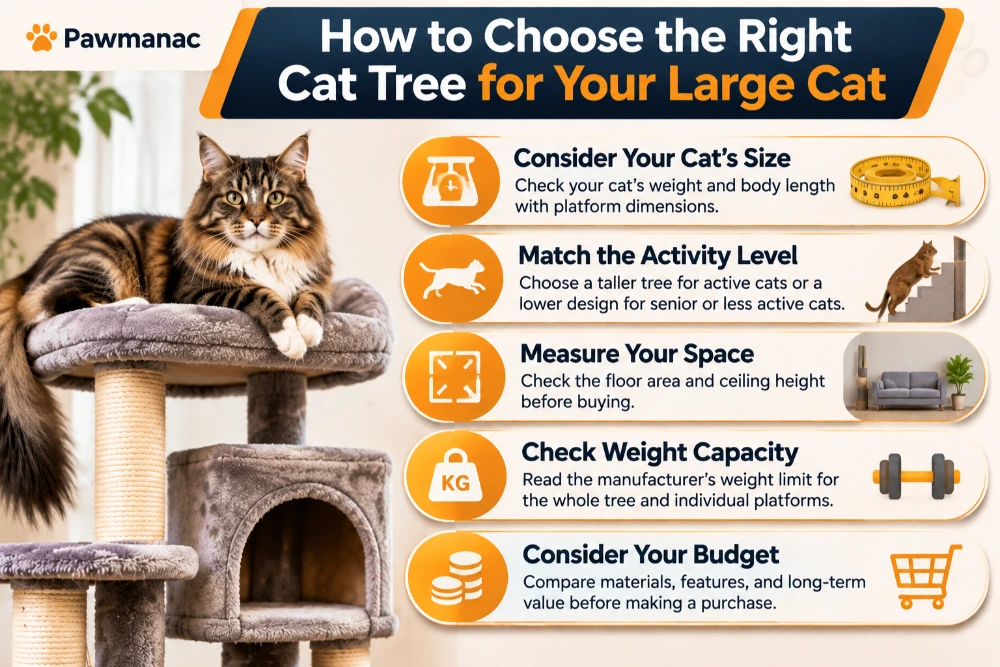
Choosing the right furniture becomes easier when you consider your cat’s individual needs rather than focusing only on product ratings.
Consider Your Cat’s Weight and Body Length
Start by measuring your cat and checking its current weight. Weight alone doesn’t tell you whether a platform will be comfortable.
A long-bodied cat may need a larger resting area even if it weighs less than another cat with a shorter, heavier build.
Compare your cat’s measurements with the platform and bed dimensions listed by the manufacturer.
Match the Tree to Your Cat’s Activity Level
An energetic cat that enjoys jumping and climbing may appreciate a taller multi-level structure.
Pay attention to your cat’s body language when it explores different heights and resting areas. Its tail movements can also give you clues about its comfort and mood while using the cat tree.
Some cats enjoy sitting on elevated platforms to observe their surroundings and watch their owners move around the house. Understanding why your cat stares at you can help you learn more about this curious behaviour.
A relaxed cat that spends much of its day sleeping may benefit more from large beds and spacious condos.
If your cat is older or has mobility difficulties, prioritize easy access and lower resting areas instead of maximum height.
Measure Your Available Floor Space
Before ordering, measure the area where you plan to place the cat tree.
Consider the full footprint, including any platforms or hammocks that extend beyond the base. Also check ceiling clearance if you’re considering a tall tower.
Leave enough surrounding space for your cat to jump onto the structure comfortably.
Check Weight Capacity Carefully
Always read the manufacturer’s weight specifications.
Some manufacturers provide a total weight capacity, while others specify the maximum load for individual platforms. These figures aren’t interchangeable.
If the manufacturer doesn’t publish a clear weight limit, contact the seller before buying rather than assuming the structure can support your cat.
Consider Your Budget and Long-Term Value
A low-priced cat tree may look attractive, but weak construction or undersized platforms can make it a poor investment.
Compare the materials, replacement parts, warranty, assembly requirements, and customer feedback.
A well-built cat tree that meets your pet’s needs may provide better long-term value than repeatedly replacing cheaper furniture.
Cat Tree vs. Cat Tower vs. Cat Condo: What’s the Difference?
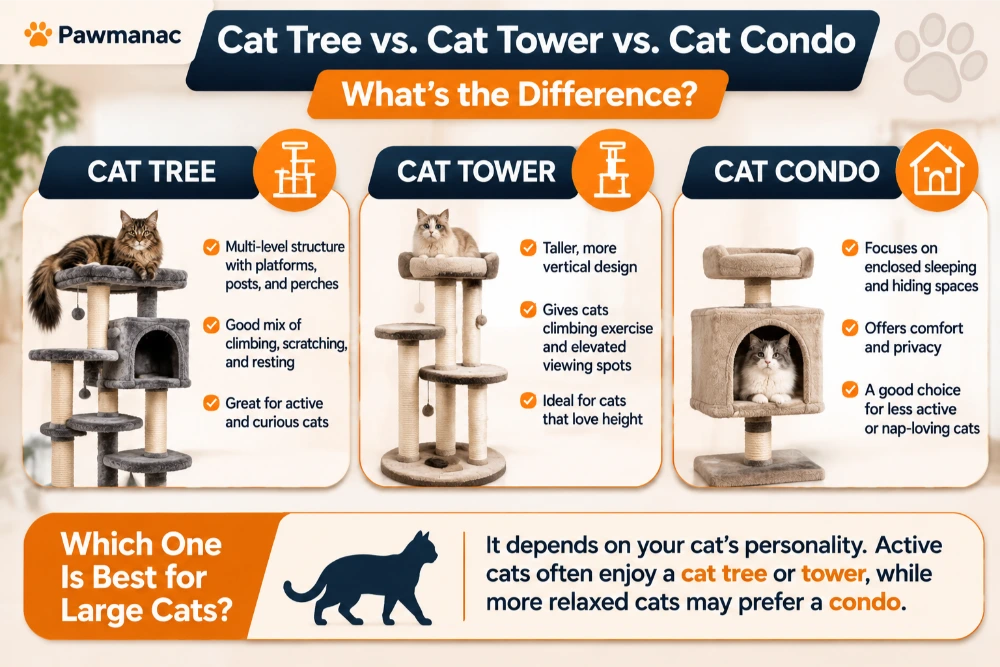
These terms are often used interchangeably, but they can describe different furniture styles.
Cat Tree: Usually includes several platforms, scratching posts, and climbing levels. It provides a combination of activity and resting areas.
Cat Tower: Often has a taller, more vertical structure designed to give cats climbing opportunities and elevated viewing spots.
Cat Condo: Typically focuses more on enclosed sleeping areas, hiding spaces, and comfortable resting locations.
For large cats, the best choice depends on their preferences. An active Maine Coon may enjoy a spacious climbing tree, while a less active Ragdoll may prefer a lower condo with oversized beds.
Some products combine all three designs, offering scratching surfaces, enclosed houses, and elevated platforms in one structure.
Are Wall-Mounted Cat Trees Better for Large Cats?
Wall-mounted cat furniture can be an alternative to traditional freestanding towers, especially when floor space is limited.
These systems use shelves, platforms, bridges, and climbing structures attached to the wall. They can create a customized vertical playground for cats without occupying as much floor area.
Catastrophic Creations, for example, offers wall-mounted furniture made with solid bamboo and reinforced steel brackets.
However, wall-mounted furniture must be installed correctly. The mounting hardware should be suitable for the wall material and secured to structural supports where required.
Consider the following before choosing a wall-mounted system:
- Confirm the manufacturer’s weight limits.
- Locate appropriate wall studs or structural supports.
- Follow the installation instructions.
- Check the spacing between shelves.
- Make sure platforms are large enough for your cat.
- Consider your cat’s jumping ability and mobility.
Wall-mounted systems aren’t automatically safer than freestanding cat trees. Their safety depends on proper installation and the suitability of each component.
How to Make a Cat Tree Safer for Large Cats
Even a sturdy cat tree needs proper assembly, placement, and maintenance.
A few precautions can help reduce unnecessary movement and wear.
Assemble Every Component Correctly
Follow the manufacturer’s instructions and use all supplied fasteners. Tighten connections properly, and don’t leave unused screws or loose brackets.
Avoid modifying the structure in ways that could affect its stability.
Use the Wall Safety Strap
If your cat tree includes an anti-tip strap, install it according to the manufacturer’s instructions.
This is particularly important for tall towers, active cats, and homes where multiple pets may climb the same structure.
Place It on a Level Surface
A cat tree should sit on a flat, stable floor. Uneven flooring can make the structure wobble, even if the base is relatively heavy.
If necessary, use a suitable non-slip mat that doesn’t interfere with the stability of the base.
Inspect It Regularly
Check the structure every few weeks for loose bolts, damaged platforms, torn fabric, and worn scratching posts.
Tighten fasteners when needed and replace damaged components according to the manufacturer’s guidance.
Stop using a structure if it becomes unstable or has damaged supports that could fail.
Frequently Asked Questions:
The Bottom Line:
Choosing the best cat tree for large cats means looking beyond height, appearance, and the XXL label. Your cat needs enough space to rest comfortably, sturdy posts for scratching, a stable base, and a structure that supports its weight.
The PAWZ Road 72-inch Cat Tree is worth considering for active cats that enjoy multiple levels, while the Prestige 46-inch Heavy Duty Cat Tree offers a lower design with spacious resting areas. Premium options such as Sopapets and solid wood furniture from New Cat Condos are also worth exploring.
Before making a purchase, measure your cat, compare individual platform dimensions, check the manufacturer’s weight limits, and consider how easily your pet can move between levels.
A well-chosen cat tree can give your large feline a comfortable place to climb, scratch, sleep, and observe its surroundings while adding useful vertical space to your home.


One Comment