Cat Tail Meanings: What Your Cat’s Tail Is Telling You
Your cat walks into the room with her tail straight up like a flag. A minute later the same tail is thrashing against the sofa. Same cat, very different message.
A cat’s tail is one of the best ways to understand her mood. Cats cannot tell you how they feel, but their tails say a lot, from “hello, I’m happy to see you” to “back off right now.” This guide explains what every common tail position and movement means, how to read the tail together with the rest of your cat’s body, and when a tail signal means your cat needs a vet.
Your cat’s vocalizations provide additional clues, so understanding why your cat meows so much can help you interpret her communication more accurately.
The quick answer:
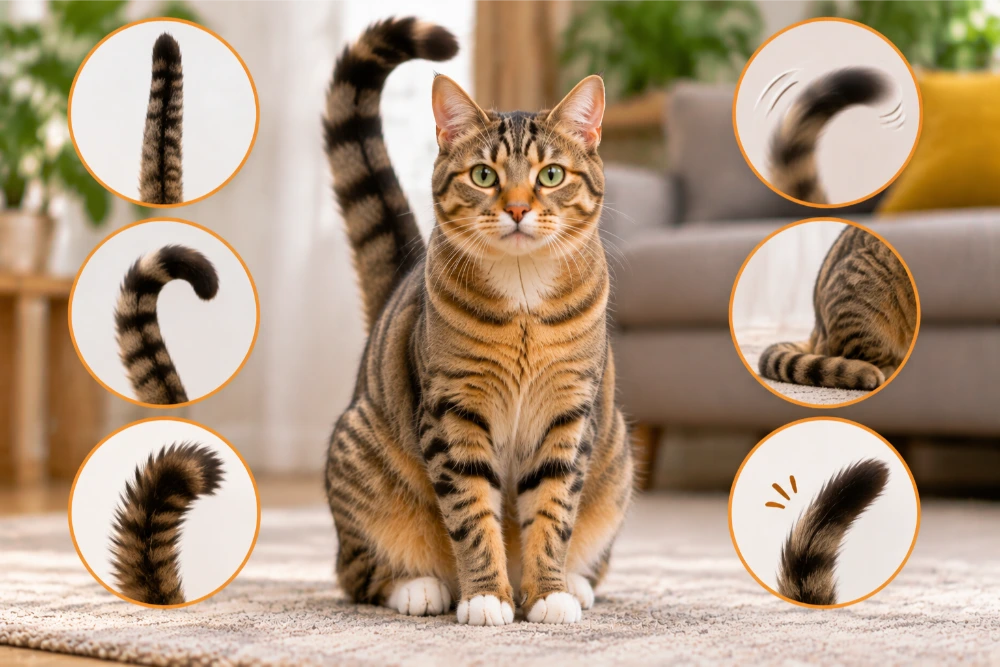
A tail held up means a happy, confident cat. A tail with a curled tip is a friendly hello. A low or tucked tail means fear or stress. A puffed-up tail means a frightened cat. A thrashing or thumping tail means irritation. A slow swish or twitching tip often means focus or hunting. Always check the ears, eyes, and body too, because the tail alone can mislead.
In this guide:
- Cat tail meanings chart
- Tail positions explained
- Tail movements explained
- Read the whole cat, not just the tail
- What to do for each mood
- Why cats have tails
- Tail questions: crooked tails, no tails, tail chasing
- When a tail signal means see a vet
- Frequently asked questions
Cat Tail Meanings Chart:
Use this chart for a fast answer. The sections below explain each one in more detail.
| Tail signal | Usually means | What to do |
| Straight up | Happy, confident, friendly | Say hello, pet the cheeks, or play |
| Up with a curled tip | A friendly greeting | Greet her softly and invite her over |
| Up and quivering | Excited to see you. Can also be marking (spraying) | Check the surroundings. See your vet if marking is frequent |
| Up, with fur puffing at the base | Overstimulated | Stop petting and give her space |
| Held level or low | Cautious or relaxed. Some breeds carry the tail low | Look at the ears and body for more clues |
| Tucked under the body | Scared, stressed, or in pain | Give space, remove the trigger, see a vet if it lasts |
| Puffed up like a bottle brush | Frightened or threatened | Back away. Do not touch her |
| Wrapped around her own body | Warm and settled, or scared, in pain, or unwell | Check the surroundings. See a vet if it lasts for days |
| Wrapped around you or another cat | A friendly greeting, like a hug | Enjoy it, and pet her if she wants |
| Slow swish from side to side | Focused, undecided, or about to pounce | Offer a wand toy |
| Fast swish or thrashing | Irritated or angry | Stop touching her and give her room |
| Thumping on the floor | Annoyed | Stop what you are doing |
| Twitching tip | Hunting, playing, or mildly annoyed | Read the situation. Is she watching a toy or bird? |
| Limp, dragging, or unable to lift | Possible injury or nerve problem | Call a vet right away |
Tail Positions Explained:
Tail straight up
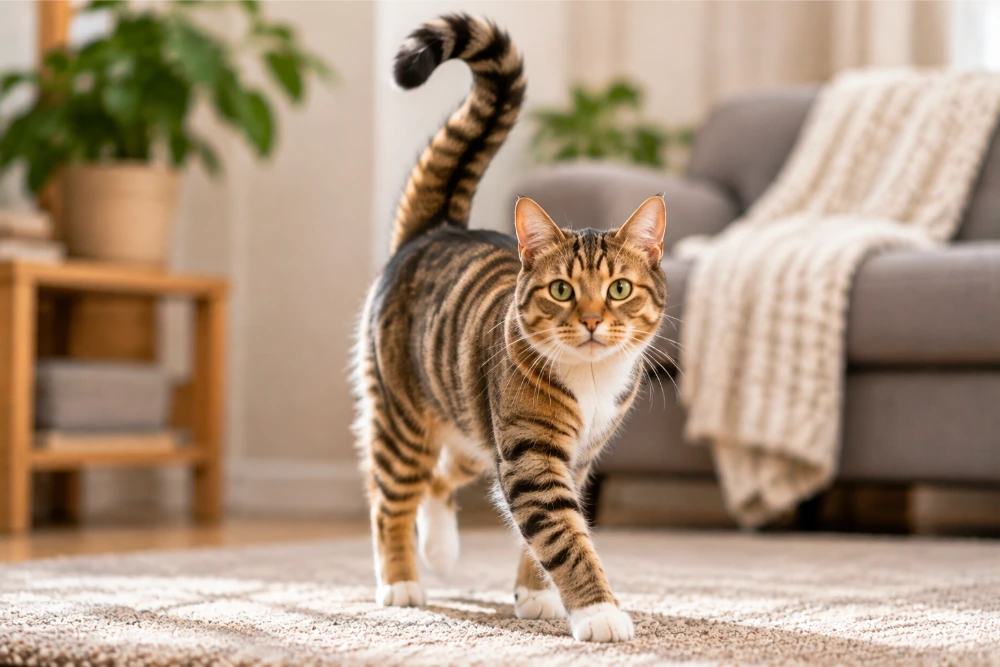
A tail held high is one of the happiest signals. Your cat feels confident and sociable, and she is approaching in a friendly way. It is how kittens greet their mothers. A study at the University of Southampton, described by PetMD, found that cats were willing to approach a cat-shaped silhouette with a raised tail, but hesitated when the silhouette’s tail was lowered. One exception: if the fur at the base of an upright tail puffs up, your cat may be overstimulated. Stop petting, because a bite can follow.
Tail up with a curled tip
When the tail stands up but curls at the end like a question mark or a hook, your cat is happy and friendly. It is an invitation to interact. Before you reach for the tail, remember that most cats prefer petting around the cheeks, under the chin, and near the ears.
Tail up and quivering
A shaking, quivering tail held upright often means your cat is very excited to see you or another cat. It can also happen when a cat backs up to a vertical surface and marks it with urine. If you see the second behavior, talk to your vet, because spraying is often a sign of stress.
Tail held low or level
A tail below the level of the back can show a serious or cautious mood, or stress. Context matters, though. Some breeds, such as Persians, simply carry their tails lower. Compare it with your own cat’s normal tail position, and look at the ears and body for clues.
Tail tucked under the body
A tail tucked between the legs or under the body is a sign that your cat is scared, anxious, or submissive. It can also mean pain. Give her time and space, and remove whatever is worrying her. If the tail stays tucked for more than a few days, have your vet check her.
Puffed-up tail
A tail that fluffs out like a bottle brush is a classic fear signal. The fur stands on end so your cat looks bigger, and it often comes with an arched back and hissing. Your cat feels threatened and wants to be left alone. Common triggers are other animals outside, dogs, visitors, and sudden noises.
Do not try to touch or comfort a cat in this state. Remove the trigger if you can, and let her calm down. If you approach her, she may see you as a threat and bite or scratch.
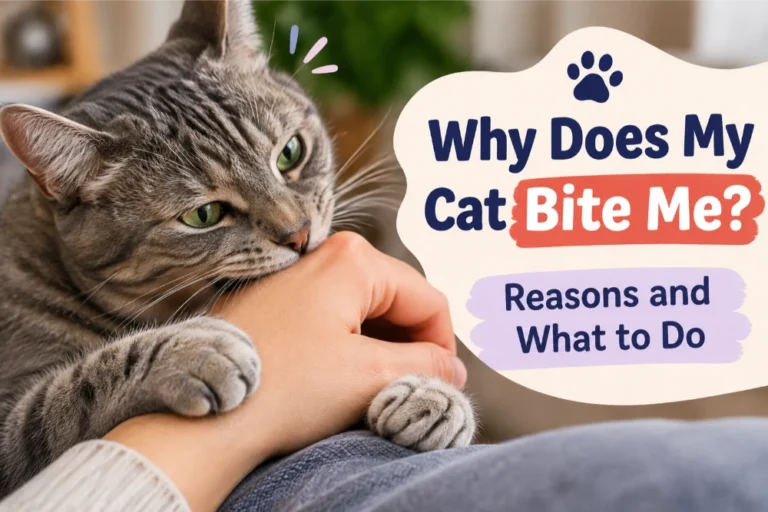
Fear and overstimulation can also trigger defensive behaviour, so understanding why your cat bites you can help you recognize when she needs space.
Tail wrapped around her own body
A cat who is sitting or lying down with her tail wrapped around her body may simply be getting cozy and warm. But it can also mean she is scared, defensive, in pain, or unwell. Look at the rest of her. A relaxed cat with soft eyes is probably just comfortable. A tense, crouched cat is not. If you see the tight-wrapped posture often for more than a few days, ask your vet to check for pain or illness.
Tail wrapped around you or another cat
This is a cat hug. Cats curl their tails around the people and cats they like as a friendly greeting. It is a sign of trust and willingness to interact.
Tail Movements Explained:
Position tells you part of the story. Movement tells you the rest.

Slow swishing
A slow, smooth swish from side to side usually means your cat is focused on something, like a toy, another animal, or a bird outside. She may be about to pounce. It can also mean she is undecided. If she is hunting, let her play. It is good exercise.
Fast swishing or thrashing
A fast, whipping tail means your cat is irritated, annoyed, or angry. Something is bothering her. If you are petting her when it starts, stop. Cats use this as a “back off” signal, and if it is ignored, it can lead to hissing, swatting, or biting.
Thumping
A tail thumping on the floor or sofa is another sign of annoyance. It often shows up when you pet a cat who has had enough, or when something disturbs her rest.
Twitching tip
A tail that twitches only at the end can mean two things. During hunting or play, it shows excitement and focus. When your cat is not playing, a twitching tip usually means mild irritation or frustration. Look at what she is doing.
Slow, soft wag
Cats do wag their tails, but not the way dogs do. A gentle, relaxed movement, often with a soft curve at the tip, can show contentment. A big, energetic swish may mean play. A fast, hard wag means the opposite. This is one big difference between cats and dogs, where a wagging tail usually means happy.
Read the Whole Cat, Not Just the Tail:
A tail is only one part of a cat’s body language. Other behaviours, including eye contact, can also reveal your cat’s feelings, so learn why your cat stares at you and what those looks might mean. Always check the ears, eyes, whiskers, body, and sounds together. The same tail can mean different things in different situations.
| Tail | Rest of the body | What it probably means |
| Up | Ears forward, soft eyes, slow blinks, walking toward you | Happy and friendly |
| Thrashing | Ears turned sideways or flat, wide pupils | Irritated. Stop and give space |
| Puffed | Arched back, flattened ears, hissing | Frightened and defensive |
| Low or tucked | Crouched body, ears back, hiding | Scared or in pain |
| Twitching tip | Fixed gaze, crouched, wiggling hindquarters | Hunting mode |
| Wrapped around you | Rubbing against your legs, purring | Affectionate greeting |
Remember that every cat is an individual. Learn what your own cat’s tail does when she is calm, so you can spot a change.
What to Do for Each Mood:
| Your cat is… | What to do |
| Happy and friendly | Greet her, pet her head and cheeks, and offer a play session. Keep petting short. |
| Playing or hunting | Let her stalk. Use a wand toy so she can pounce on the toy, not on your hands. |
| Annoyed or overstimulated | Stop petting right away and give her space. Do not wait for a bite. |
| Scared or defensive | Remove the trigger, lower the noise, and give her a quiet place to hide. Do not corner her. |
| Possibly in pain | Watch for other changes and call your vet. Do not push her to interact. |
Why Do Cats Have Tails?
Cats’ tails do more than communicate. According to Cats Protection, tails help in four ways:
- Balance. Cats use their tails as a counterweight when they walk along narrow ledges, jump, or climb, a bit like a tightrope walker using their arms.
- Communication. The tail shows mood to people and other cats.
- Sensing. The tail has many nerve endings, so a cat can feel if something touches it from behind.
- Warmth. A cat can wrap a fluffy tail around her body like a blanket.
Quick facts about cat tails
- A cat’s tail is an extension of her spine and contains roughly 19 to 23 small bones, and she controls it voluntarily from base to tip.
- Tail bones make up around 10% of all the bones in a cat’s body.
- Most cat tails are about 25 to 28 cm (10 to 11 inches) long.
- Domestic cats are the only cats that can walk with the tail straight up in the air.
- A cat’s tail is very sensitive. Never pull it. It can cause pain and lasting nerve damage.
Tail Questions: Crooked Tails, No Tails, and Tail Chasing
Why does my cat chase her tail?
Often it is play. A moving tail at the edge of her vision can look like prey. This is common in kittens as they learn to hunt. Adult cats may do it now and then. If your cat chases her tail a lot, she may be bored, so add daily play with a wand toy and other activities. If she bites or attacks her own tail, talk to your vet.
Why do some cats have no tail?
Some breeds are born without a tail or with a very short one. The Manx is the best-known tailless breed, and bobtail cats have very short tails. These traits come from a genetic mutation. Cats without tails use their inner ear for balance and other body language to communicate. The same mutation can also affect the spine and nerves, which raises the risk of painful arthritis at a young age.
Cats that lose a tail in an accident usually adapt well. They learn to balance and communicate in other ways.
Why does my cat have a crooked tail?
Two common reasons are an old injury or a genetic trait. Some Siamese cats have a natural kink in the tail, though this is becoming less common. If you notice a new bend or change in your cat’s tail, see your vet.
When a Tail Signal Means See a Vet
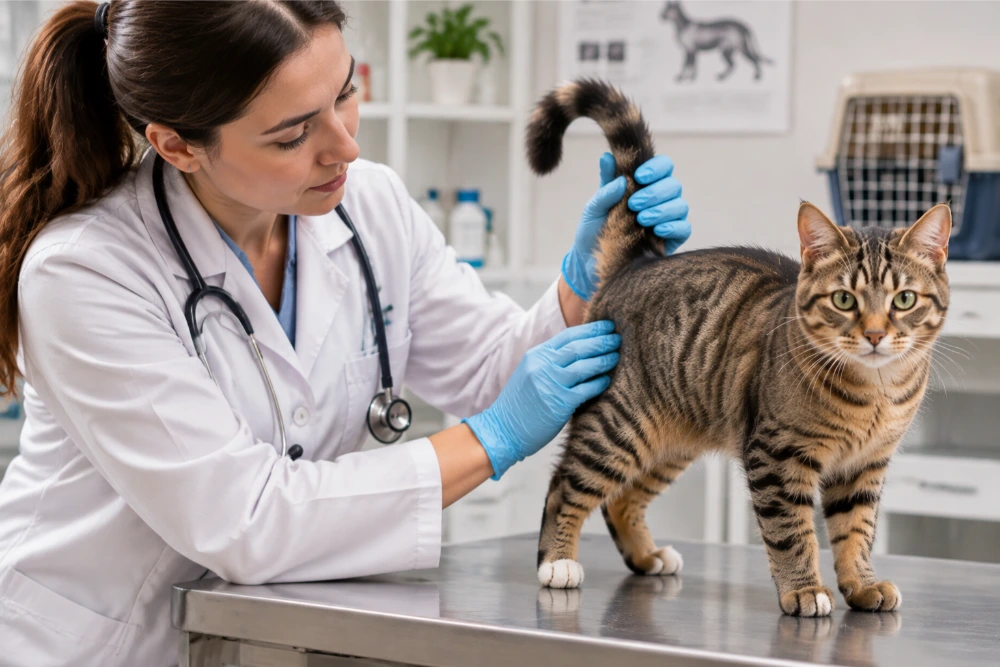
Most tail signals are everyday communication. But tail changes can also be early signs of pain or illness. See your vet if:
- Your cat’s tail hangs limp, drags, or she cannot lift it, especially after a fall or if the tail was pulled or caught
- The tail stays tucked or tightly wrapped around her body for more than a few days
- Rapid or unusual tail movements come with other changes in behavior
- She licks, chews, or bites her tail, or it looks swollen or injured
- She seems to be in pain when her tail or back end is touched
- She sprays or marks often, since stress or a health problem could be the cause
Watch for other signs too, such as hiding, eating less, using the litter box differently, or sudden aggression. These can all point to pain.



One Comment