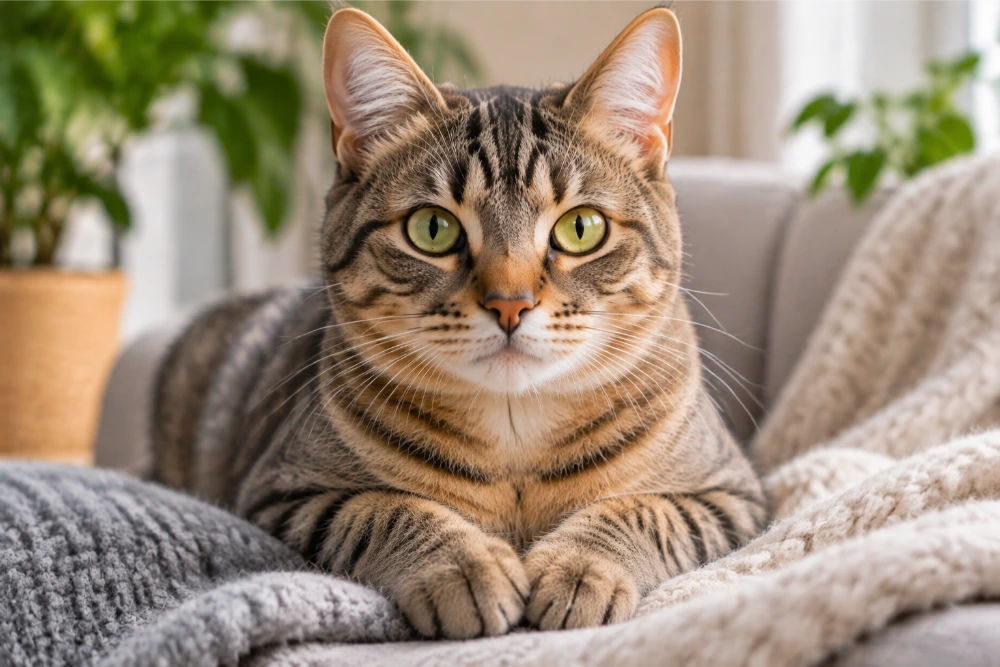
Why Does My Cat Stare at Me? 7 Reasons and What to Do
Your cat is sitting across the room, staring directly at you. You look away for a moment, and then look back, and those eyes are still fixed on you. Sometimes your cat watches you while you work, follows you around the house, or sits beside your bed and stares while you sleep.
So, why does your cat stare at you? Is it showing affection, asking for something, or trying to tell you that something is wrong?
Cats stare for several reasons, including curiosity, affection, hunger, attention-seeking, and play. They may also stare when they feel frightened, threatened, or uncomfortable. The meaning depends on the situation and your cat’s other body-language signals, such as ear position, tail movement, posture, and blinking.
In this guide, you’ll learn seven common reasons cats stare at their owners, how to interpret their eye contact, what different staring behaviors mean, and when it’s time to contact a veterinarian.
Quick Answer: Why Does My Cat Stare at Me?
Most cats stare at their owners because they are curious, want attention, expect food, or feel comfortable around them. A relaxed gaze accompanied by slow blinking can indicate trust, while a stare followed by playful movements may mean your cat wants to interact. However, a hard, unblinking stare combined with flattened ears, a stiff body, growling, or raised fur may indicate fear or defensive aggression. If your cat suddenly starts staring unusually or shows other changes in behavior, a veterinary check may be necessary.
| What your cat does | Possible meaning | How you should respond |
| Stares and slowly blinks | Relaxation or trust | Slowly blink back |
| Stares around mealtime | Hunger or anticipation | Check the feeding schedule |
| Watches you while you work | Curiosity | Let your cat observe |
| Stares and brings a toy | Wants to play | Offer an interactive toy |
| Stares and rubs against you | Wants attention or contact | Interact if your cat seems relaxed |
| Stares with flattened ears | Fear or discomfort | Give your cat space |
| Chewing fingers (kittens) | Possible defensive behavior | Avoid prolonged eye contact and back away calmly |
These are general clues rather than definite interpretations. Your cat’s individual personality and the surrounding situation matter.
7 Reasons Your Cat Stares at You:
1. Your Cat Is Showing Affection and Trust
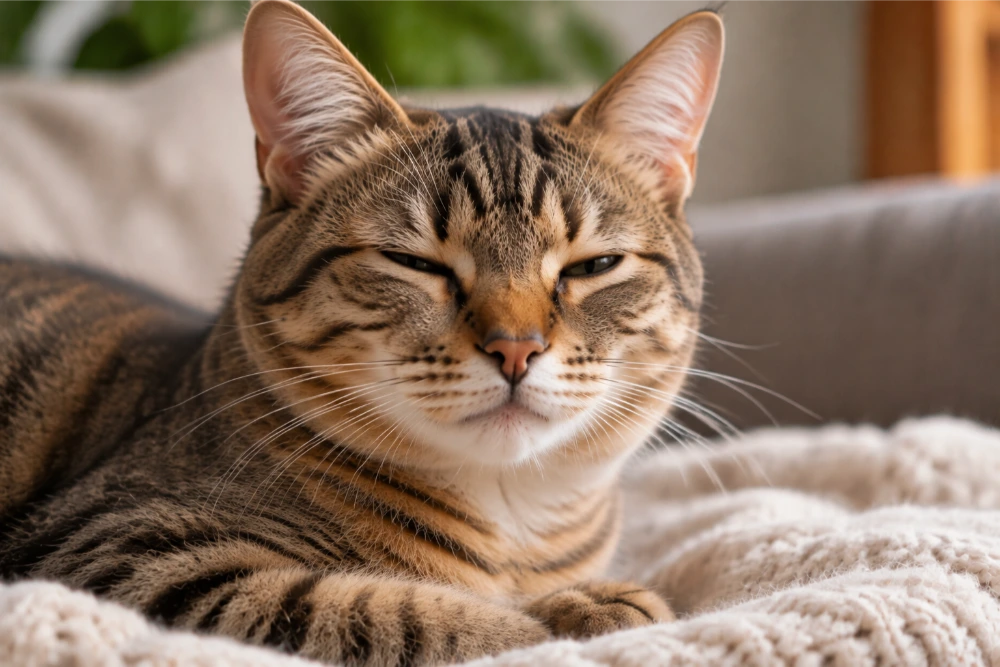
One possible reason your cat stares at you is that it feels safe and comfortable around you. Cats communicate through body language, and relaxed eye contact can be part of their social interaction with familiar people.
You might notice your cat sitting beside you on the sofa, watching you quietly, or resting nearby with relaxed eyes. Some cats combine this behavior with gentle purring, rubbing against your legs, or slow blinking.
Slow blinking is particularly interesting because cats sometimes use relaxed eye closure during positive interactions with people. If your cat looks at you and slowly closes and opens its eyes, you can try returning the gesture.
You don’t need to approach or touch your cat every time it makes eye contact. Sometimes, simply sharing a quiet moment is enough.
What to do: When your cat looks relaxed, soften your gaze and blink slowly. Let your cat decide whether it wants to come closer.
2. Your Cat Wants Food or Treats
If your cat starts staring at you around breakfast or dinner time, hunger may be the simplest explanation.
Cats learn household routines surprisingly well. They may recognize the sound of a food container, remember when you usually prepare their meals, or notice that you’re heading toward the kitchen.
Some cats sit near their bowls and stare until their owners respond. Others follow their owners, meow, rub against their legs, or alternate between looking at the person and looking toward the food.
Your cat may also stare while you’re eating because it hopes to receive a small piece of your meal.
Over time, this behavior can become a learned habit. If you frequently provide treats immediately after your cat stares at you, it may repeat the behavior because it has worked before.
What to do: Maintain a consistent feeding schedule and provide an appropriate amount of nutritionally complete cat food. Make sure fresh water is available, and avoid giving extra food every time your cat demands it.
If your cat suddenly becomes much hungrier than usual, especially alongside weight loss or increased thirst, contact your veterinarian rather than assuming it simply wants more food.
3. Your Cat Is Curious About What You’re Doing
Have you ever noticed your cat staring at you while you type on a laptop, fold laundry, cook dinner, or follow your morning routine?
Your cat may simply be observing you.
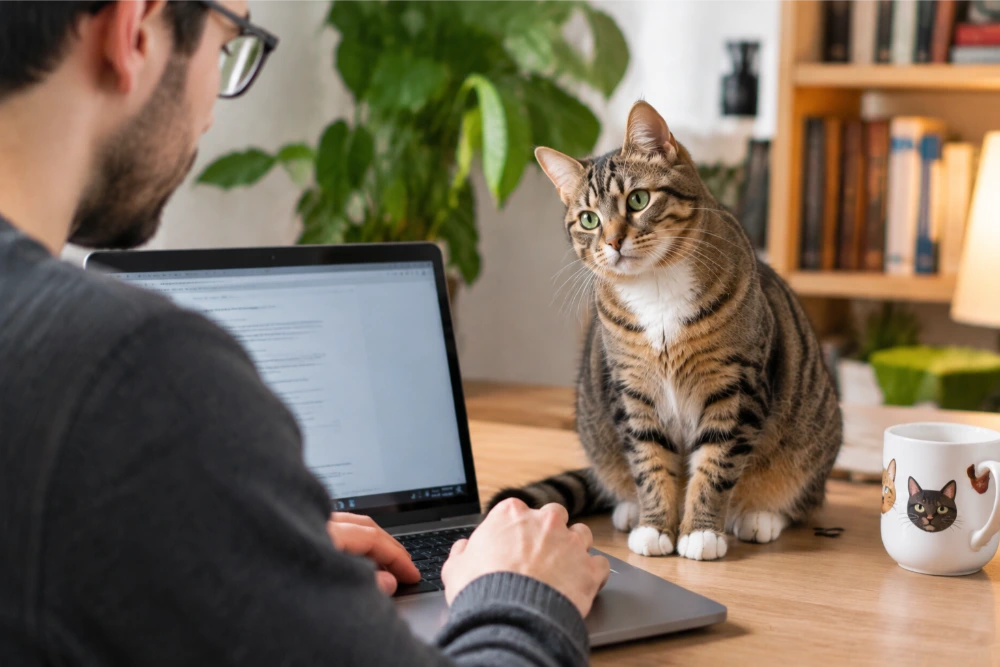
Cats are attentive animals that respond to movement, sounds, and changes in their surroundings. Your hands moving across a keyboard, a cupboard opening, or a new object appearing in the room can capture their attention.
Because cats spend time watching their environment, ordinary household activities can become interesting to them. Your cat may also learn to associate certain movements with familiar events, such as preparing food or getting ready to leave the house.
You might even notice your cat watching you complete an activity that seems uninteresting to everyone else. From your cat’s perspective, the movement and sounds may be worth investigating.
What to do: There’s generally no need to interrupt your cat’s quiet observation. If your cat appears interested in an activity, you can offer a safe toy or a suitable place to sit nearby.
4. Your Cat Wants Attention or Companionship
Cats have different personalities. Some enjoy being close to their owners throughout the day, while others prefer to interact only when they feel like it.
Cats also use vocal sounds to communicate their needs, so understanding why your cat meows so much can provide additional clues about its behaviour.
If your cat frequently stares at you while sitting nearby, it may be looking for companionship or an opportunity to interact.
You may notice additional behaviors, including:
- Meowing or making soft chirping sounds.
- Rubbing its face against your legs.
- Walking toward you and looking back.
- Jumping onto your lap.
- Pawing gently at your arm.
- Sitting near you and waiting for a response.
The exact meaning depends on what happens next. A relaxed cat that approaches you may want petting, while another cat may simply prefer to sit in the same room.
Not every cat expresses affection by cuddling. Quietly choosing to spend time near a familiar person can also be part of its normal social behavior.
What to do: If your cat seems comfortable, offer a gentle interaction or a short play session. Pay attention to its preferences, and let it move away when it wants space.
5. Your Cat Wants to Play
A cat staring at you can also be preparing for play.
This is especially common in kittens and energetic young cats. You might see your cat crouching low, watching your movements, widening its pupils, or moving its tail before suddenly running toward you.
Your cat may be inviting you to start a game, or it may be waiting for an opportunity to chase something that moves.
Other clues include:
- Staring at your feet as you walk.
- Hiding behind furniture while watching you.
- Pouncing toward your ankles.
- Bringing a toy and looking at you.
- Alternating between watching you and running around the room.
These behaviors can be part of normal play and hunting-related activity. However, staring alone doesn’t prove that your cat is preparing to pounce. Look at its posture and movements for additional clues.
What to do: Offer a wand toy, feather toy, or another suitable interactive toy. Regular play gives your cat an appropriate way to chase, stalk, and pounce without treating your hands or feet as toys.
If your cat often bites during play, avoid encouraging it to attack your hands. Redirect the behavior toward a toy instead.
6. Your Cat Feels Frightened, Stressed, or Threatened
Not every cat stare is friendly.
Sometimes, a cat stares because it is monitoring something that makes it uncomfortable.
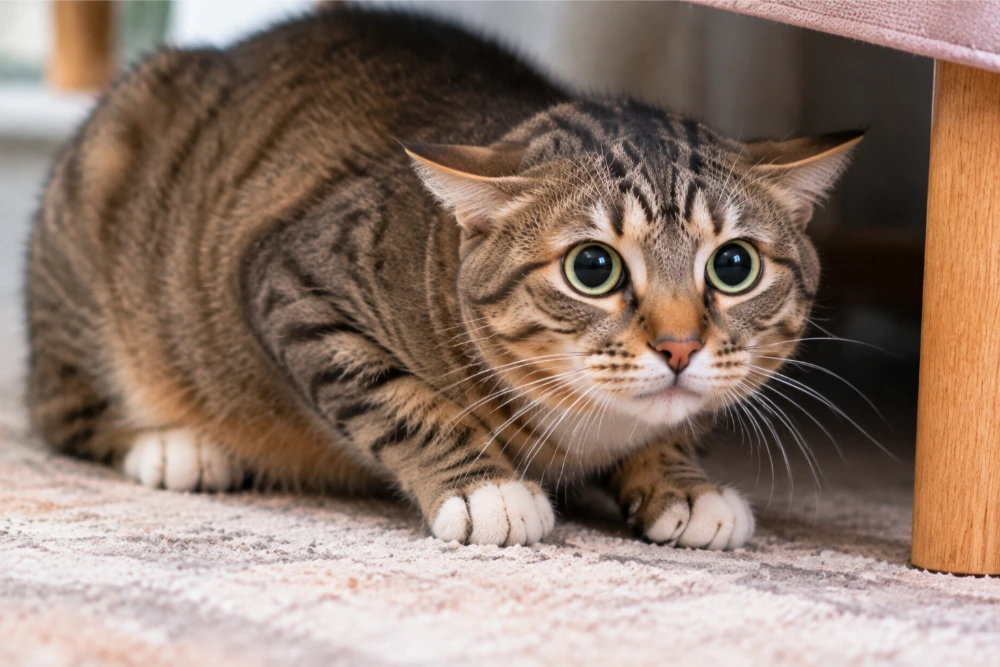
A sudden noise, unfamiliar visitor, new pet, or unexpected movement may cause your cat to freeze and watch carefully.
In this situation, staring can be part of a defensive response. Your cat may be trying to assess what is happening before deciding whether to approach, hide, or move away.
Look for other signs of fear or stress, including:
- Ears turned sideways or flattened backward.
- A crouched or stiff body.
- Dilated pupils.
- Fur standing up along the back or tail.
- Hissing, growling, or defensive swatting.
- A tucked tail or an attempt to hide.
A hard stare combined with tense posture can also be a warning to keep your distance.
If you see these signals, avoid staring directly into your cat’s eyes, reaching toward it, or trying to pick it up. Those actions may increase its discomfort.
What to do: Give your cat room to move away and provide access to a quiet hiding place. If a particular sound, person, or animal appears to be triggering the reaction, reduce the disturbance when possible.
Never punish your cat for showing fear or defensive behavior. If the behavior is frequent or difficult to manage, ask your veterinarian about appropriate next steps.
7. Your Cat May Be Uncomfortable or Experiencing a Health Problem
A cat’s staring behavior deserves closer attention when it changes suddenly or occurs alongside other unusual symptoms.
For example, a cat that has always watched you from across the room may simply be following its normal routine. However, a cat that suddenly becomes withdrawn, stares unusually, or behaves differently may need a health assessment.
Watch for changes such as:
- Reduced appetite or unusual hunger.
- Increased thirst or changes in urination.
- Hiding more often than usual.
- Unusual vocalization or restlessness.
- Changes in walking, jumping, or balance.
- Squinting, redness, cloudiness, or other visible eye changes.
- Reduced responsiveness to familiar people or surroundings.
Staring by itself is not enough to diagnose a medical problem. The important consideration is whether it is accompanied by other symptoms or a noticeable change from your cat’s usual behavior.
If your cat seems disoriented, has difficulty walking, experiences sudden vision problems, or has a seizure, seek urgent veterinary care.
What to do: Contact your veterinarian if the behavior is new, persistent, or accompanied by other changes. Describe when the staring happens, how long it lasts, and what other symptoms you’ve noticed.
What Does Your Cat’s Body Language Mean When It Stares?
The eyes provide only part of the picture. Your cat’s ears, tail, posture, and movements can help you understand whether it feels relaxed, wants something, or needs space.
Use this guide to interpret the overall situation.
| Body-language signal | Possible interpretation | Recommended response |
| Soft eyes and slow blinking | Relaxation or trust | Return a gentle slow blink |
| Upright ears and relaxed posture | Interest or comfort | Observe or interact gently |
| Ears turned sideways or backward | Discomfort, fear, or irritation | Pause interaction and give space |
| Dilated pupils and crouching | Excitement, fear, or play, depending on context | Check for other signals |
| Fast tail swishing | Irritation or heightened arousal | Stop petting if your cat seems uncomfortable |
| Puffed-up fur and a stiff body | Fear or defensive behavior | Move away calmly |
| Hissing or growling during eye contact | Strong discomfort or a warning | Do not approach or handle the cat |
Body language varies between individual cats, and a single signal can have more than one explanation. For example, dilated pupils may occur during play, fear, or excitement. Consider the whole situation rather than relying on one physical clue.
For a more detailed explanation, read our guide to cat tail meanings and learn how tail movements can provide additional information about your cat’s mood.
Why Does My Cat Stare at Me Without Blinking?
A cat that stares without blinking can look intense, but the behavior doesn’t automatically mean that it is angry.
Your cat might be concentrating on your movements, waiting for food, watching something interesting, or monitoring a situation that makes it uncertain.
The rest of its body helps you interpret the stare.
If your cat is sitting comfortably with a relaxed body and neutral ears, it may simply be observing you. If its body becomes stiff, its ears flatten, its fur rises, or it begins growling, the stare may indicate fear or defensive behavior.
Cats also stare when they are tracking movement. If you’re holding a toy or moving your hands, your cat may be concentrating on what you’re doing.
Should you stare back? Avoid turning it into a prolonged staring contest. If your cat appears relaxed, you can soften your gaze and blink slowly. If it seems tense or frightened, look away and give it space.
Why Does My Cat Stare at Me While I Sleep?
Some cats seem particularly interested in watching their owners at night. You might wake up and discover your cat sitting beside the bed, looking at your face.
There are several possible explanations.
Your cat is following its routine. Cats may be active or alert during parts of the night when their owners are sleeping. Your cat may be awake and observing its surroundings.
Your cat wants food or attention. If your cat has learned that you respond when it wakes you, it may repeat the behavior to request food, play, or interaction.
Your cat enjoys being nearby. Some cats prefer resting close to familiar people. Watching you while sitting nearby may simply be part of spending time with you.
Your cat has noticed movement or a sound. Small movements under blankets, changes in breathing, or sounds around the room can attract a cat’s attention.
If your cat otherwise behaves normally, nighttime staring is not usually a reason for concern on its own.
If the behavior repeatedly interrupts your sleep, provide regular play opportunities during the day and maintain a consistent feeding routine. Avoid rewarding persistent nighttime demands with treats every time they occur.
Why Does My Cat Stare at Me and Slowly Blink?
Slow blinking is often associated with relaxed, positive interactions between cats and people.
When your cat looks at you with soft eyes and slowly closes and opens its eyelids, it may be showing that it feels comfortable in your presence.
You can try the following:
- Sit comfortably at a distance your cat prefers.
- Look toward your cat without forcing prolonged eye contact.
- Slowly close your eyes and open them again.
- Wait to see whether your cat responds or continues relaxing.
Your cat may slow-blink back, look away, or simply remain where it is. All of these responses can be normal.
A slow blink is not a guaranteed declaration of love, and you shouldn’t interpret every blink in the same way. However, when it occurs alongside relaxed posture and other comfortable behaviors, it can be a positive sign of trust.
If your cat is squinting persistently, keeping one eye closed, or showing redness or discharge, don’t assume it is slow-blinking affectionately. Contact your veterinarian to rule out an eye problem.
How to Respond When Your Cat Stares at You
The best response depends on what your cat appears to need. Instead of immediately petting it or offering food, take a moment to observe its behavior.
1. Check Your Cat’s Body Language
Look at the ears, tail, posture, and eyes. A relaxed cat may welcome interaction, while a tense cat may need space.
2. Consider the Timing
Does your cat stare before meals, during playtime, or when you’re getting ready for bed? Recognizing a pattern can help you understand what may be triggering the behavior.
3. Offer Appropriate Interaction
If your cat seems playful, use a suitable toy. If it approaches with relaxed body language, you can offer gentle attention. Let your cat choose whether to continue interacting.
4. Avoid Punishment and Forced Contact
Don’t yell at your cat, grab it, or force it to accept petting. These responses can increase fear and damage trust.
5. Monitor Any Changes
If staring becomes unusually frequent or is accompanied by changes in appetite, activity, vision, or behavior, contact your veterinarian.
Understanding your cat’s normal habits makes it easier to recognize when something is different.
When Should You Worry About Your Cat Staring at You?
Most ordinary staring behavior does not require veterinary treatment. However, you should seek professional advice when it occurs with concerning symptoms.
Contact your veterinarian if your cat:
- Suddenly begins staring or behaving differently.
- Appears confused or unusually unresponsive.
- Develops visible eye problems.
- Stops eating or shows a significant change in thirst.
- Becomes unusually withdrawn or restless.
- Shows changes in movement, balance, or coordination.
Seek urgent veterinary care for sudden vision loss, seizures, collapse, severe disorientation, or other serious symptoms.
If possible, record a short video of the behavior and note when it happens. This information can help your veterinarian understand what you’ve observed.
Do not attempt to diagnose a health problem based on eye contact alone. A veterinary examination is the appropriate way to investigate persistent or unusual changes.
Frequently Asked Questions:
The Bottom Line:
If you’re wondering, “Why does my cat stare at me?” the answer depends on your cat’s behavior and the situation. It may be showing affection, watching what you’re doing, asking for food, seeking attention, or preparing to play. In other situations, staring can be a response to fear, discomfort, or a health concern.
Pay attention to your cat’s eyes, ears, tail, and overall posture rather than interpreting the stare by itself. Respond with gentle interaction when your cat appears comfortable, and give it space when it seems tense or frightened.
Most importantly, learn what is normal for your cat. If its staring behavior changes suddenly or occurs with other unusual symptoms, consult a veterinarian.
This article is for general informational purposes and is not a substitute for veterinary advice.



2 Comments