Why Do Dogs Sleep So Much?
If your dog seems to sleep all day, you are not imagining it. Dogs sleep far more than people do — and for most healthy dogs, that is completely normal.
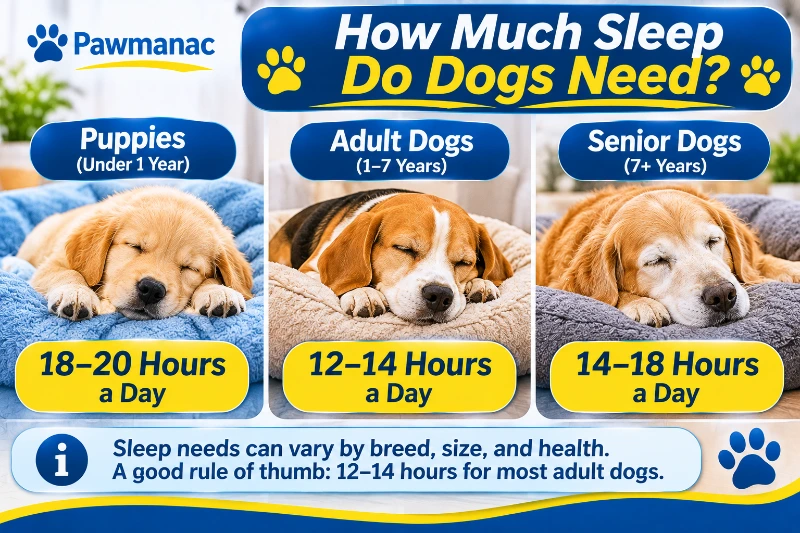
An adult dog typically sleeps about 12 to 14 hours in 24 hours, according to the American Kennel Club (AKC). Puppies sleep even more, usually 18 to 20 hours a day, and senior dogs often need 14 to 18 hours. On top of sleep, dogs spend roughly another 30% of the day awake but resting, and only about 20% truly active.
So a dog that naps after a walk, naps after lunch, and naps again in the evening is usually just being a dog. The question worth asking is not “why does my dog sleep so much?” but “has my dog’s sleep changed?”
This guide explains how much sleep is normal at each age, why dogs sleep so much, and the changes that mean a vet visit.
In this guide
- How many hours do dogs sleep?
- Why do dogs sleep so much?
- Do some breeds sleep more than others?
- Why is my puppy sleeping so much?
- Why is my senior dog sleeping all day?
- When is sleeping too much a problem?
- How to help your dog sleep better
- Frequently asked questions
How Many Hours Do Dogs Sleep?
Sleep needs change a lot with age. Use the table below as a starting point, then compare your dog with its own usual pattern — that change matters more than any single number.
| Dog’s age | Typical total sleep in 24 hours |
|---|---|
| Puppy (under 1 year) | 18–20 hours |
| Adult (about 1–7 years) | 12–14 hours |
| Senior (about 7+ years, earlier for large breeds) | 14–18 hours |
Sources do not agree to the hour, and that is worth knowing. VCA Animal Hospitals gives 8 to 13.5 hours a day for adult dogs, while the AKC’s 12–14 hour figure is the one most owners quote. The exact number depends on breed, size, activity, health and the weather. A healthy, active adult Labrador that sleeps 11 hours and a healthy adult Greyhound that sleeps 15 hours can both be normal.
Dogs also sleep differently from people. They are polyphasic sleepers, which means they sleep in many short bursts through the day and night instead of one long block. They spend more time in light sleep and less in deep REM sleep than humans, so they wake easily — and fall back asleep easily too.
Why Do Dogs Sleep So Much?

1. It is how their bodies recover
Sleep is when a dog’s body repairs muscle, supports the immune system and processes what it learned that day. Puppies need extra sleep because growth itself is tiring work: their central nervous system, muscles and immune system are all still developing.
2. They are built to conserve energy
Dogs descend from wolves, animals that rest between hunts and save energy for the next burst of activity. A pet dog with regular meals has no hunt to prepare for, so much of that rest time simply stays as sleep. Large breeds, which burn more energy just moving around, tend to sleep more than small, busy breeds.
3. Boredom and a quiet house
A dog with little to do will sleep. Dogs left alone for long stretches, or dogs that get one short walk and then hours with nothing to do, often sleep simply because there is nothing else to do. That is not always a health problem — but it is a sign they may need more exercise, play and mental stimulation during their waking hours.
4. Age
Puppies sleep more because they are growing. Senior dogs sleep more because their metabolism slows, their joints ache and they tire faster. A gradual increase in sleep as a dog ages is expected; a sudden increase is not.
5. Weather and season
Many dogs sleep more on hot days, cold rainy days and in winter, when they are less active outdoors. A seasonal pattern that returns to normal when the weather improves is usually nothing to worry about.
Do Some Breeds Sleep More Than Others?
Yes. As a rule, larger and lower-energy breeds sleep the most.
- Sleepiest breeds: Great Dane, Mastiff, Newfoundland, Saint Bernard, Greyhound, Bulldog, Chow Chow, Shih Tzu and Basset Hound — often 14–18 hours a day as adults.
- Lightest sleepers: Border Collie, Australian Shepherd, Jack Russell Terrier, Siberian Husky and other high-energy working breeds — often closer to 10–12 hours, if they get enough exercise. Without it, they may sleep more out of boredom, or become restless instead.
Breed is only a starting point. Two dogs of the same breed can still sleep very different amounts.
Why Is My Puppy Sleeping So Much?
Puppies usually sleep 18 to 20 hours a day, according to the AKC, and that is normal. A young puppy may play hard for 30 minutes, then fall asleep mid-game. Growth, learning and new experiences all use a lot of energy.
Let a sleeping puppy sleep — waking them constantly can make them overtired and grumpy, much like a tired toddler. Make sure they have a quiet, comfortable place to rest, and keep their waking time short, positive and full of gentle play, toilet breaks and training.
Call your vet if a puppy is hard to wake, will not eat, has diarrhoea or vomiting, or suddenly sleeps far more than it did last week.
Why Is My Senior Dog Sleeping All Day?
Senior dogs need more rest, and the AKC notes most older dogs need around 12 to 15 hours a day, with some sources giving up to 18 hours. Slower metabolism, arthritis, weaker senses and less stamina all add up.
Help an older dog by giving them a soft, warm bed in a quiet spot, keeping a regular routine, and breaking exercise into shorter, gentler walks rather than one long one. Watch for changes that go with the extra sleep: stiffness getting up, confusion at night, toileting accidents, loss of appetite or weight loss. Those deserve a vet check, not just a longer nap.
When Is Sleeping Too Much a Problem?
Extra sleep alone is rarely an emergency. Extra sleep plus a change is the warning sign. Contact your vet promptly if you notice any of these alongside a change in sleep:
- Hard to wake, or unusually groggy when awake
- Loss of appetite, or drinking much more or much less than usual
- Weight loss or sudden weight gain
- Limping, stiffness, or trouble getting up stairs
- Vomiting, diarrhoea, coughing or laboured breathing
- Hiding, loss of interest in walks, play or people
- Sudden change in sleep over days, not months
Possible causes a vet may check include hypothyroidism, diabetes, depression, pain from arthritis, infections and heart disease. Do not try to diagnose these at home — the same symptom can have many causes, and the treatment is different for each.
Call a vet the same day if your dog collapses, has a seizure, cannot stand, or is struggling to breathe.
How to Help Your Dog Sleep Better
- Give them enough daytime activity. A tired dog sleeps better at night. Match exercise to age and breed — puppies need short bursts, adults need a good walk and play, seniors need gentle, regular movement.
- Keep a routine. Regular meal times, walks and bedtime help a dog settle.
- Make the bed comfortable. A quiet corner away from draughts, with a bed that supports their joints, matters more as dogs age.
- Add mental stimulation. Sniffing games, puzzle feeders and short training sessions tire a dog out without tiring their body. A bored dog that only sleeps all day may simply need more to do while awake.
- Keep feeding safe. Treats should be no more than 10% of daily calories. If you share human food, check it is safe first — see our guide to what human foods dogs can eat.
Frequently Asked Questions
The Bottom Line
Most dogs sleep 12 to 14 hours a day, puppies up to 20 hours, and seniors a little more — and that is normal. Dogs sleep in short bursts, conserve energy between activities, and sleep more when they are young, old, large, bored or tired.
Do not compare your dog with a single number. Learn what is normal for your dog, and pay attention when that pattern changes suddenly, or when extra sleep comes with appetite loss, weight change, stiffness or low mood. That change, not the total hours, is what should send you to the vet.
This article is for general information. It is not a substitute for advice from your veterinarian.
Sources
- American Kennel Club: How Much Sleep Do Puppies Need?
- How Much Sleep Do Dogs Need? (akc.org)
- VCA Animal Hospitals: Is My Pet Sleeping Too Much? (vcahospitals.com)
- PDSA: Dogs and sleep (pdsa.org.uk)