Can Dogs Eat Grapes?
Can Dogs Eat Grapes? No — and of all the foods on the never-feed list, grapes may be the most deceptive. They look like the perfect dog treat: small, sweet, and bite-sized. But grapes, raisins, currants, and sultanas can cause sudden kidney failure in dogs, and there is no known safe amount. A dog can eat grapes one day with no obvious problem and be in serious trouble after eating them another day.
Because the reaction is so unpredictable, vets treat every grape ingestion as an emergency. This guide explains what makes grapes dangerous, why no dose can be called safe, the signs of poisoning and how fast they develop, and what to do the moment you realize your dog has eaten one.
The quick answer:
No — dogs should never eat grapes, raisins, currants, or sultanas, in any amount. These fruits can cause acute kidney failure in dogs, and even a single grape has been enough to make a small dog critically ill. If your dog has eaten any of them, do not wait for symptoms: call your vet or the ASPCA Animal Poison Control Center at (888) 426-4435 immediately.
Grapes verdict at a glance:
| Form | Verdict | Why |
|---|---|---|
| Fresh grapes (any color, seeded or seedless) | Never | Can cause acute kidney failure; no safe dose is known |
| Raisins | Never | The dried form of the same fruit — just as toxic, and easy for a dog to eat in handfuls |
| Currants and sultanas | Never | Same grape family, same kidney risk |
| Grape juice | Never | Made from the same fruit; the suspected toxin is still present |
| Raisin bread, fruitcake, and trail mix | Never | Raisins hidden in baked goods still count — and trail mix often adds chocolate and nuts |
| Grape jelly and jam | Avoid | Mostly sugar with little fruit, but there is no reason to risk it — choose a dog-safe treat instead |
In this guide:
- Why grapes are so dangerous for dogs
- Grapes, raisins, currants, and sultanas: every form counts
- How many grapes are dangerous — the honest answer
- Signs of grape poisoning and the timeline
- What to do if your dog ate grapes
- Safe fruits you can share instead
Why grapes are so dangerous for dogs:
For years, vets knew grapes could shut down a dog’s kidneys without knowing exactly why. The current leading explanation is tartaric acid, a natural acid found in grapes. Dogs appear to be unusually sensitive to it, and its concentration varies from grape to grape depending on the variety, ripeness, and where it was grown — which helps explain why reactions are so unpredictable.
Once the toxin is absorbed, the damage centers on the kidneys. The kidneys’ filtering tubes are injured, urine production falls, and waste products that should leave the body start to build up in the blood. Without treatment, this can progress to complete kidney failure within a few days. Some dogs are stopped at the stomach-upset stage; others are not. There is currently no test that can tell in advance which dogs will react badly — another reason grapes sit permanently on the never-feed list in our guide to what human foods can dogs eat.
Grapes, raisins, currants, and sultanas: every form counts:
Owners are often surprised that the danger is not limited to a fresh bunch of grapes. Every form of the fruit carries the same risk:
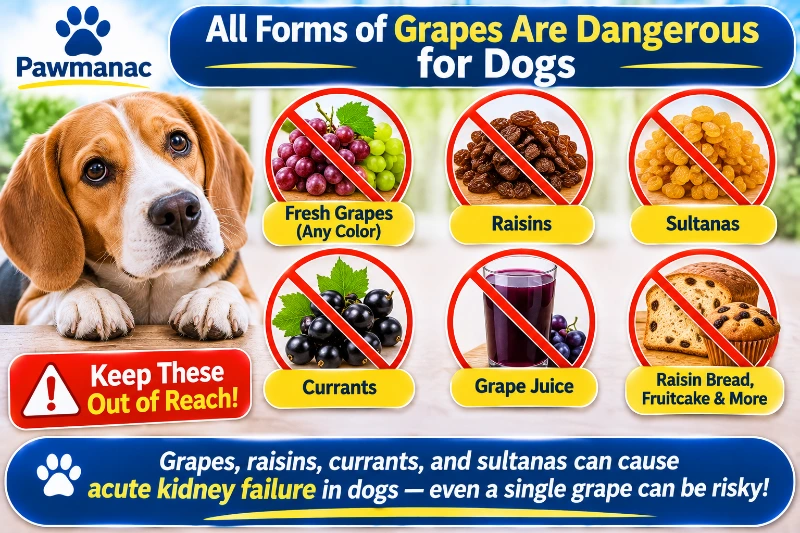
- Fresh grapes — red, green, or black, seeded or seedless. Seedless is not safer; the toxin is in the fruit itself.
- Raisins are simply dried grapes, so they carry the same toxin in a smaller, more concentrated package — and a dog that finds a box can eat dozens in seconds.
- Currants and sultanas are also grape varieties (true currants used in baking are dried grapes), and they are treated as equally dangerous.
- Grape juice counts too, as do foods made with it.
- Baked goods — raisin bread, fruitcake, oatmeal raisin cookies, mince pies, and trail mix — hide raisins in exactly the foods that get left on counters and coffee tables during holidays.
If it started life as a grape, keep it away from your dog.
How many grapes are dangerous:
The honest answer is that nobody knows a safe number — and that is precisely what makes grapes different from a food like chocolate, where risk can at least be estimated from the dose and the dog’s weight. With grapes, there is no established toxic threshold:
- Kidney failure has been reported in small dogs after eating just one or two grapes.
- Other dogs have eaten larger amounts with no apparent effect — which does not mean the next time will go the same way, because tartaric acid levels vary from grape to grape.
- Body weight does not protect a dog the way it does with some other toxins. Small dogs are at higher risk from a given amount simply because they are small, but large dogs have developed kidney failure too.
The practical rule follows from the uncertainty: any amount is treated as a poisoning. Do not try to judge whether your dog “only had a couple.” Call the vet, tell them how many you think were eaten and when, and let them decide the next step.
Signs of grape poisoning:
The first sign is almost always vomiting, often within a few hours of eating — sometimes with pieces of grape or raisin visible in it. The typical pattern unfolds like this:
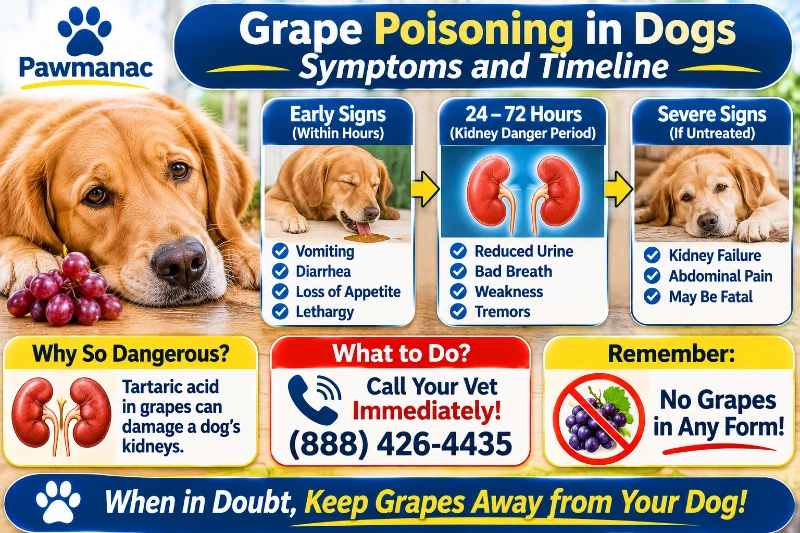
- First few hours: vomiting, followed by diarrhea, lethargy, and loss of appetite. The dog may seem quiet, uncomfortable, or unusually thirsty.
- 24 to 72 hours: if the kidneys are failing, urine production drops — the dog may strain to urinate or stop urinating altogether. Bad breath with a chemical or ammonia-like smell, mouth ulcers, abdominal pain, weakness, and tremors can develop.
- Severe cases: without treatment, kidney failure at this stage can be fatal.
The dangerous trap is the middle stage: many dogs seem to improve after the vomiting passes, right around the time the kidney damage is quietly beginning. That is why treatment should never wait for the later signs.
What to do if your dog ate grapes:
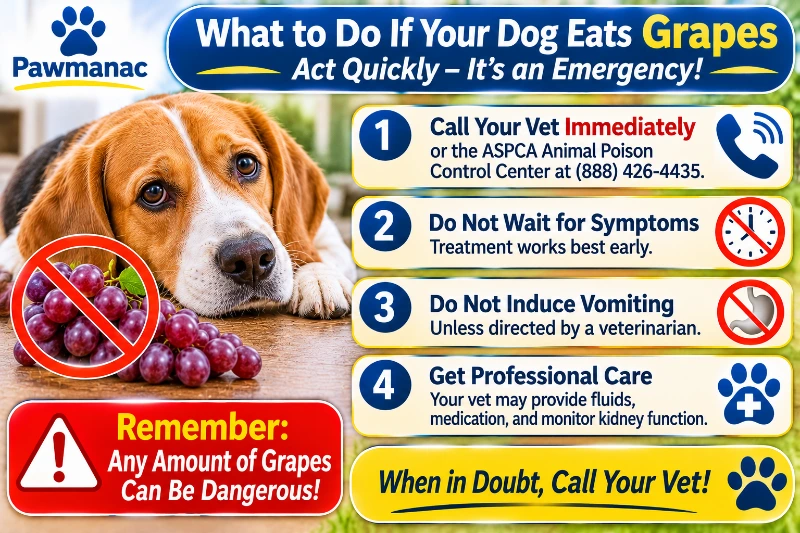
Treat it as an emergency from the first minute, even if your dog looks completely normal. Our emergency guide, what to do if your dog ate something toxic, covers the general steps — for grapes specifically:
- Call your vet or the ASPCA Animal Poison Control Center at (888) 426-4435 right away (a consultation fee may apply). Tell them what was eaten — grapes, raisins, or a food containing them — how much, and when.
- Do not wait for symptoms. The treatments that protect the kidneys work best in the first few hours, long before kidney damage shows up in behavior or blood tests.
- Do not induce vomiting unless a vet tells you to. Done at the right time and in the right way, it can remove grapes before they are absorbed — but it should be a vet’s call, not a home remedy.
- At the clinic, treatment usually includes safely emptying the stomach if the ingestion was recent, activated charcoal in some cases, and aggressive IV fluids for 24 to 48 hours to support the kidneys, with blood tests to monitor kidney values. Dogs treated early have a much better outlook than dogs treated after kidney failure has set in.
Safe fruits you can share instead:
If your dog loves fruit, there are safer ways to share — in small amounts, as treats rather than meals:
- Blueberries — a favorite training treat; just wash them first.
- Apple slices — remove the core and seeds first.
- Banana pieces — fine in small amounts; they are sugary, so a slice or two is plenty.
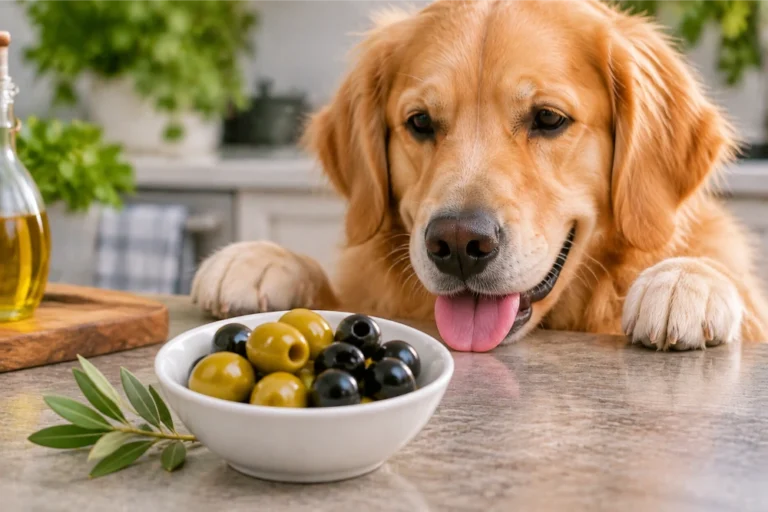
Keep portions small, introduce any new food gradually, and remember that even safe fruits are extras, not a substitute for balanced dog food. For comparison, some common human foods are merely “sometimes” foods rather than emergencies — olives, for example, are not toxic but are too salty to share often. Grapes are in a different category entirely: never, in any form.
Frequently Asked Questions:
The Bottom Line:
Grapes, raisins, currants, and sultanas are never safe for dogs — there is no known safe dose, and even one grape can be enough to cause kidney failure in a small dog. Keep them stored out of reach, warn guests not to share, and if your dog eats any, call your vet or ASPCA Poison Control at (888) 426-4435 immediately, before any signs appear.
Sources:
- American Kennel Club (AKC) — guidance on grapes and raisins toxicity in dogs
- ASPCA Animal Poison Control Center — grapes, raisins, and currants poisoning overview and hotline
- Merck Veterinary Manual — grape, raisin, and tartaric acid toxicosis in dogs
- Pet Poison Helpline — grapes and raisins toxicity in dogs
- VCA Hospitals — grape, raisin, and currant poisoning in dogs