Can Dogs Eat Onions?
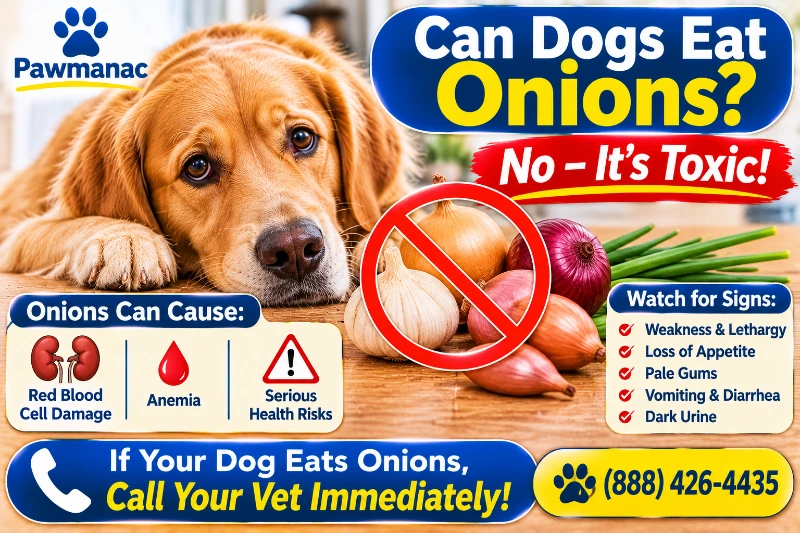
Can Dogs Eat Onions? No — and this is one of the clearest “never feed” answers in dog nutrition. Onions belong to the Allium family, and every member of that family is toxic to dogs: onions, garlic, chives, leeks and shallots. It does not matter whether the onion is raw, cooked, fried or powdered. If it is in the food, the food is not safe for your dog.
Onions are also one of the easiest toxins for a dog to meet by accident — they hide in soups, sauces, gravies, baby food and takeout leftovers. This guide covers why they damage a dog’s body, which forms are most dangerous, how much is too much, and what to do if your dog gets into them.
The quick answer:
No. Dogs should never eat onions in any form — raw, cooked, dehydrated or powdered — and the same goes for garlic, chives, leeks and shallots. These plants contain compounds that damage a dog’s red blood cells, causing hemolytic anemia — and symptoms are often delayed by several days, making the poisoning easy to miss until it is advanced. If your dog has eaten a meaningful amount of onion or garlic, call your vet or ASPCA Animal Poison Control at (888) 426-4435 rather than waiting for symptoms.
Onion verdict at a glance:
| Form | Verdict | Why |
| Raw onion | Never feed | Toxic compounds are fully active; a common cause of poisoning from stolen food and table scraps |
| Cooked onion | Never feed | Cooking does not destroy the toxin; onion in soups, sauces and stir-fries is just as dangerous |
| Onion powder | Never feed — worst form | Dehydrated and concentrated — a teaspoon carries far more toxin than fresh onion |
| Garlic (all forms) | Never feed | Roughly 5 times more potent than onion by weight; garlic powder is especially concentrated |
| Chives, leeks, shallots | Never feed | Same Allium family, same red-blood-cell damage |
| Foods cooked with onion | Never feed | Gravy, soup, baby food and sauces all carry the toxin even if you pick the onion pieces out |
In this guide:
- Why onions are dangerous for dogs
- Which forms of onion are worst
- How much onion is dangerous, by dog size
- Signs of onion poisoning — and why they show up late
- What to do if your dog ate onion
- Safer ways to flavor your dog’s food
Why onions are dangerous for dogs:
Onions and their relatives contain organosulfur compounds, including one called N-propyl disulfide. When a dog eats onion, these compounds attack the red blood cells. They damage the hemoglobin — the protein that carries oxygen — and cause the cells to form clumps known as Heinz bodies, which the dog’s body then destroys faster than it can replace them.
The result is hemolytic anemia: too few working red blood cells to carry oxygen around the body. A dog with anemia is starved of oxygen, which is why the signs include weakness, rapid breathing and collapse. In severe cases the dog can die without treatment.
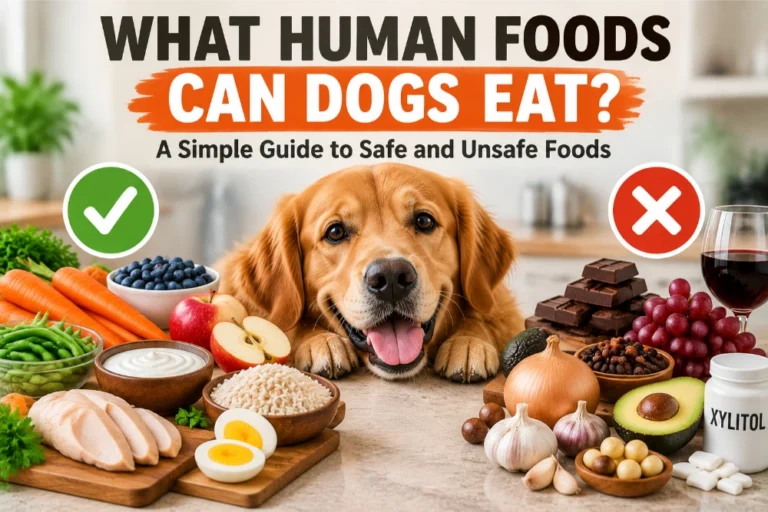
Humans handle these compounds without trouble — your dog’s red blood cells are simply more fragile than yours, which is why onion poisoning surprises so many owners. It is also why onions sit firmly on the never-feed side of what human foods can dogs eat — there is no preparation method that makes them safe.
The damage is also cumulative: smaller amounts fed again and again over several days — onion-heavy table scraps every night, say — can poison a dog just as a single large dose can, with red blood cells being destroyed the whole time.
Which forms of onion are worst:
Every form counts, but they are not equal. From most to least concentrated:
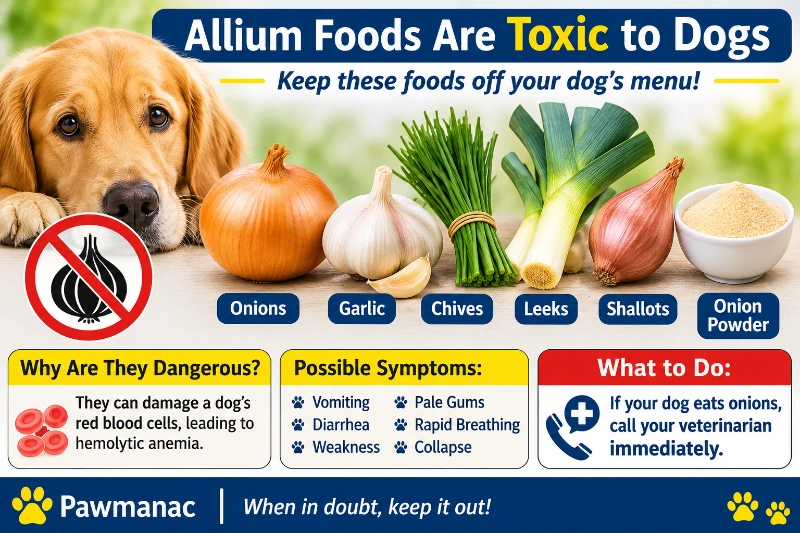
Onion and garlic powder are the most dangerous forms. Drying removes the water, so a spoonful of powder holds the compounds of a much larger amount of fresh onion. Powders also hide where you would never think to look: seasoning mixes, gravy granules, soup mixes, rotisserie chicken skin, and some baby foods (onion powder is a common baby food ingredient, which matters because baby food is sometimes fed to sick dogs). Always read the label before sharing processed food.
Garlic is more potent than onion. Garlic is commonly estimated to be about five times more toxic than onion by weight. That old advice about feeding garlic to repel fleas is genuinely risky — the dose meant to help sits uncomfortably close to the dose that harms, with no good evidence it works. Skip it.
Raw and cooked onion are equally off-limits. Cooking, frying, caramelizing and pickling do not break down the toxic compounds. Onion rings, French onion soup and the onion in last night’s gravy are all the same problem. Picking the visible pieces out of a dish does not fix it either — the compounds have already spread through the food.
Chives, leeks, shallots and spring onions (scallions) seem milder, but they are Allium plants too — bulbs, green tops and all, they carry the same risk.
How much onion is dangerous, by dog size:
There is no established safe dose of onion for dogs — the only safe amount is none. Vets generally consider onion toxic at around 0.5% of a dog’s body weight — roughly 15–30 grams of onion per kilogram of body weight — but poisoning has been reported at lower amounts, especially with powders and with repeated feeding.
What that looks like in practice:
| Dog size | Weight | Amount of fresh onion in the danger zone |
| Toy / small dog | 5–10 lb (2–4.5 kg) | As little as a quarter of a medium onion |
| Medium dog | 25–40 lb (11–18 kg) | Roughly one medium onion |
| Large dog | 60–90 lb (27–40 kg) | Two to three medium onions |
Treat that table as a warning line, not a safe limit. A single meal with a lot of onion — a small dog stealing onion rings, or any dog eating a bowl of French onion soup — can be enough to poison. Powders move the line much lower: a teaspoon of onion or garlic powder in a shared dish can matter for a small dog.
Some dogs are more sensitive than others. Japanese breeds — Akitas and Shiba Inus in particular — have red blood cells that are genetically more vulnerable to this type of damage, and they can be poisoned by amounts a similar-sized dog might tolerate. Puppies, senior dogs and dogs with existing anemia or other illnesses are also at higher risk.
Signs of onion poisoning — and why they show up late:
This is the part that catches owners out: onion poisoning usually does not make a dog sick right away. Signs typically appear one to five days later, as the red blood cells fail — by which time many owners have forgotten the meal entirely.
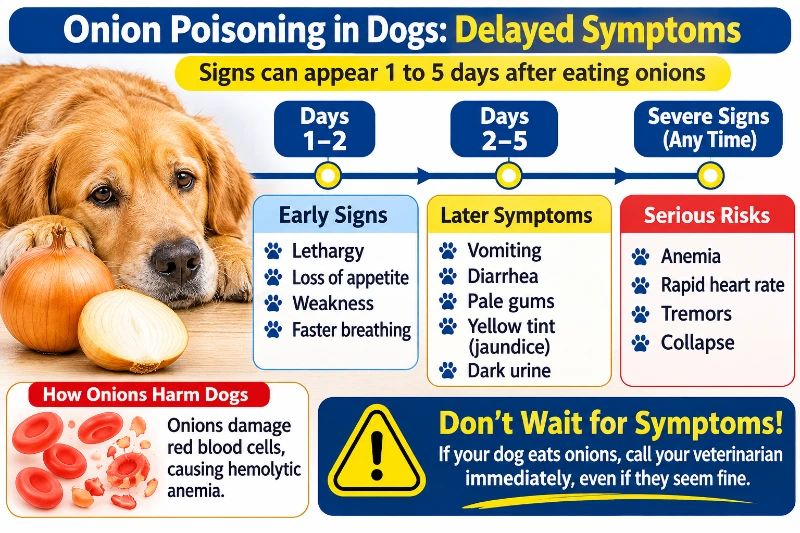
Early signs are easy to mistake for a dog simply being tired:
- Lethargy and unusual tiredness
- Weakness, wobbling or reluctance to exercise
- Loss of appetite
- Pale or white gums (healthy gums are pink)
- Faster breathing and a faster heart rate, even at rest
As the anemia worsens, signs become more obvious:
- Dark, brown or reddish urine — a hallmark of red blood cells being destroyed
- Vomiting or diarrhea
- Yellow tinge to the gums, skin or whites of the eyes (jaundice)
- Collapse in severe cases
If your dog ate onion two or three days ago and now seems tired and off his food, that delay fits onion poisoning perfectly. Do not wait another day to see — call your vet and tell them exactly what was eaten and when.
What to do if your dog ate onion:
Act on what you know, not on how your dog looks — remember, he may look fine for days.
- Remove access. Take away the food and anything else containing onion, garlic or their powders.
- Work out how much. Estimate the amount and the form (fresh, cooked or powder) and note the time. Save the packaging or recipe if you have it — the ingredient list helps your vet judge the dose.
- Call your vet, or ASPCA Animal Poison Control at (888) 426-4435. Tell them your dog’s weight, what was eaten and roughly how much. Small amounts in a large dog may only need monitoring; larger amounts, powders, small dogs and Japanese breeds usually mean a trip in.
- Do not induce vomiting unless a vet tells you to. It is not always safe or useful, and it is a decision for a professional who knows the dose and the timing.
- Follow through on monitoring. Because the damage is delayed, your vet may want blood tests over the following days to watch the red blood cell count, even if your dog seems well.
Our step-by-step guide to what to do if your pet ate something toxic walks through the first hour in more detail, including what information to have ready when you call.
Treatment for onion poisoning is supportive — there is no antidote. Vets may induce vomiting or give activated charcoal if the onion was eaten very recently, then monitor blood counts, give fluids and oxygen support, and in severe cases give a blood transfusion. Dogs treated before the anemia becomes severe usually recover well — another reason not to wait for symptoms.
Safer ways to flavor your dog’s food:
If you were reaching for onion or garlic to make your dog’s dinner more interesting, there are safer options. A spoonful of plain cooked pumpkin, a few blueberries, some steamed green beans or a little plain boiled chicken all add flavor and texture without risk. Carrots, cucumber and apple slices (seeds removed) work well too. Keep extras to a small share of the day’s calories, and introduce anything new gradually.
And a final household rule: because onions hide in so many human foods, check ingredient labels before sharing anything processed, and keep takeout containers, soup bowls and cutting-board scraps out of reach. Prevention is much easier than treatment — the same reason grapes and onion-heavy foods should never be left where a dog can counter-surf. It is also worth knowing that bacon cooked with onion or garlic carries this same risk — the onion does not become safe just because it is served with something else.
Frequently Asked Questions:
The Bottom Line:
Onions, garlic, chives, leeks and shallots are never safe for dogs in any form, because their compounds destroy red blood cells and can cause life-threatening anemia days after the meal. Keep Allium foods and powders off your dog’s menu entirely, check labels before sharing processed food, and call your vet or ASPCA Animal Poison Control at (888) 426-4435 immediately if your dog eats a meaningful amount.
Sources:
- American Kennel Club (AKC) — guidance on foods dogs should never eat, including onions and garlic
- ASPCA Animal Poison Control — toxic plant and food guidance for Allium species
- Merck Veterinary Manual — onion and garlic (Allium) toxicosis in dogs
- Pet Poison Helpline — onion poisoning in dogs: signs, timeline and treatment