Xylitol and Dogs: The Sweetener That Can Kill
Xylitol Poisoning in Dogs is one of the fastest-moving food emergencies there is. Xylitol is a sweetener found in sugar-free gum, mints, and a growing list of “sugar-free” products — harmless to people, but in dogs it can send blood sugar crashing within the hour and, at higher doses, destroy the liver over the following days. A dog that gets into a pack of sugar-free gum does not have hours to spare; it has minutes.
What makes xylitol especially dangerous is how ordinary it looks. It hides in handbags, coat pockets, glove boxes, and kitchen cupboards, in products most owners would never think of as poison. This guide covers why it is so toxic, where it hides, the signs and the timeline, and the fast action that saves dogs. It sits on the never-feed list in our guide to what human foods can dogs eat — and of everything on that list, it is the one where speed matters most.
The quick answer:
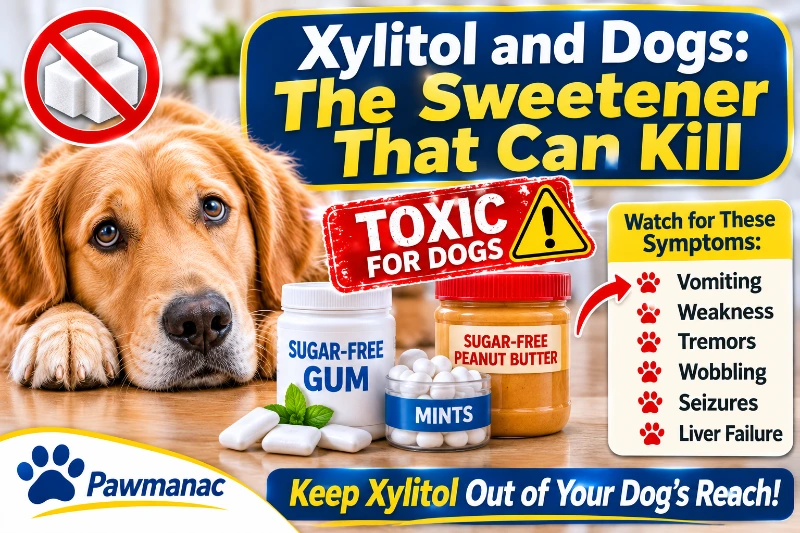
Xylitol is extremely toxic to dogs — never feed it, in any amount, in any product. In dogs (unlike people) xylitol triggers a rapid release of insulin, which drives blood sugar down to dangerous levels within 10 to 60 minutes: vomiting, weakness, collapse, and seizures can follow. Larger doses can cause acute liver failure over the next one to three days. If your dog eats anything containing xylitol, treat it as an emergency and get to a vet immediately — do not wait for signs.
Xylitol verdict at a glance:
| Question | Verdict |
|---|---|
| Safe for dogs to eat? | Never — highly toxic |
| When do signs start? | As fast as 10–60 minutes |
| Most concentrated common source | Sugar-free gum |
| Later danger | Acute liver failure at 1–3 days |
| What to do | Vet or emergency vet immediately — time-critical |
In this guide:
- Why xylitol is so dangerous for dogs
- Where xylitol hides
- Signs of xylitol poisoning and the timeline
- What to do if your dog eats xylitol
- How much xylitol is dangerous
- Keeping xylitol out of your dog’s reach
- Frequently asked questions
Why xylitol is so dangerous for dogs:
Xylitol is a sugar alcohol — a sweetener with fewer calories than sugar, used in “sugar-free” and “diabetic-friendly” products. You will also see it on labels as birch sugar or under its additive code, E967. Same ingredient, same danger.
The problem is a quirk of dog physiology. In people, xylitol barely affects insulin. In dogs, the body mistakes it for real sugar and releases a surge of insulin in response. That insulin pulls sugar out of the bloodstream, and blood sugar (glucose) plummets — a state called hypoglycemia. A dog’s brain runs on glucose, so the effects are fast and frightening: vomiting, weakness, wobbling, collapse, and seizures, sometimes within 10 to 60 minutes of eating it.
At higher doses there is a second, slower catastrophe. Xylitol can cause acute liver failure in dogs — the liver cells die, blood stops clotting properly, and the dog can bleed internally. This develops over one to three days, sometimes in dogs that seemed to recover from the initial blood-sugar crash. That two-stage pattern is why vets monitor xylitol cases for days, not hours, and why “he seems fine now” is never a reason to skip the vet.
Along with can dogs eat chocolate, xylitol is one of the very few everyday human foods that can kill a healthy dog quickly. The difference is that most owners know about chocolate. Far fewer know about the gum in their handbag.
Where xylitol hides:
Xylitol turns up in far more products than most dog owners realize:
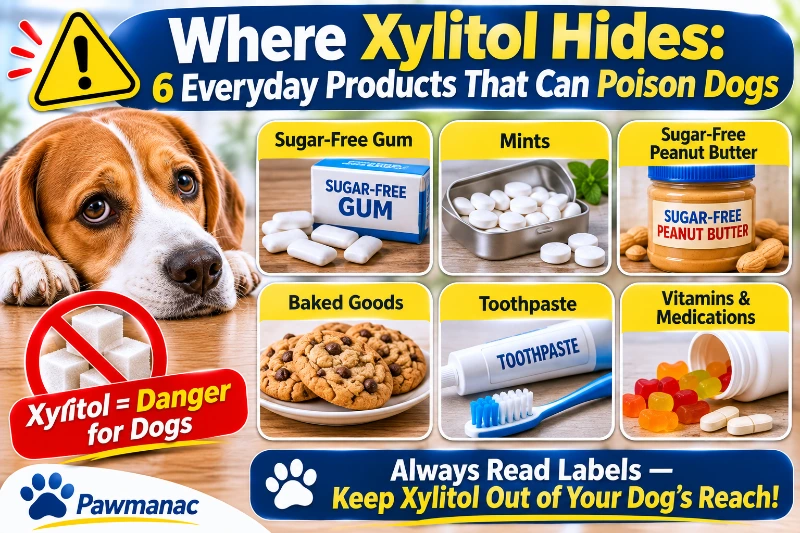
- Sugar-free gum — the most concentrated common source, and the number one cause of cases. Some brands pack close to a gram of xylitol into a single piece.
- Mints and sugar-free candy
- Sugar-free peanut butter — see the warning below; this one catches owners who are trying to do something nice for their dog
- Sugar-free baked goods and baking mixes, including homemade “keto” and diabetic recipes
- Toothpaste and mouthwash — including some pet-adjacent products; never use human toothpaste on a dog
- Medications and supplements — some children’s vitamins, melatonin gummies, nasal sprays, and liquid medicines are sweetened with xylitol
Check peanut butter labels before you share. Peanut butter is a classic dog treat — stuffed in toys, used to disguise pills — and most regular brands are perfectly fine. But some sugar-free and “natural” brands contain xylitol. Before any peanut butter goes near your dog, read the ingredients: if you see “xylitol,” “birch sugar,” or “E967,” that jar never gets opened for the dog. This one habit prevents one of the saddest and most avoidable poisonings vets see.
Signs of xylitol poisoning and the timeline:
Xylitol poisoning moves in two waves, and knowing the timeline tells you what to watch for:
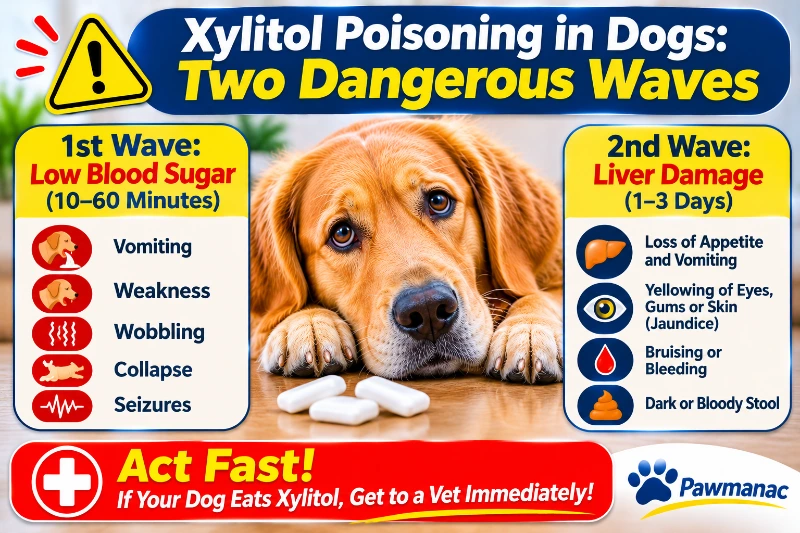
Wave 1 — low blood sugar (10–60 minutes after eating):
- Vomiting — often the very first sign
- Weakness and lethargy
- Wobbling, loss of coordination
- Collapse
- Seizures
Wave 2 — liver failure (1–3 days after eating, at higher doses):
- Loss of appetite and renewed vomiting
- Yellowing of the eyes, gums, or skin (jaundice)
- Bruising or bleeding that does not stop — the blood can no longer clot properly
- Dark or bloody stool
The cruel detail: wave 2 can arrive even if wave 1 was mild or treated successfully. That is why vets run blood tests for several days after a significant xylitol ingestion, checking both glucose and liver values, before they will call a dog out of danger.
What to do if your dog eats xylitol:
This is a true emergency — act first, read later.
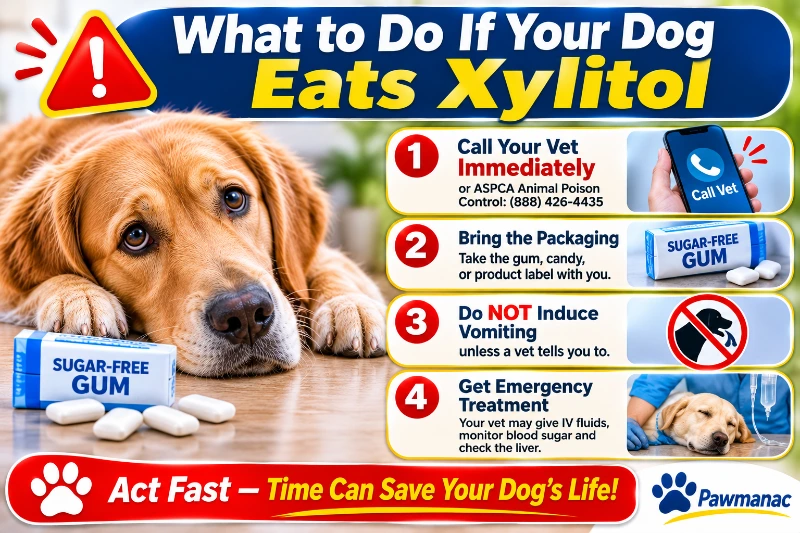
- Get to a vet now. Call your vet or the nearest emergency vet and tell them “xylitol” and how much your dog may have eaten. If you cannot reach one, call ASPCA Animal Poison Control at (888) 426-4435. Start driving — treatment works best before the blood sugar crashes.
- Bring the packaging. The product and its label tell the vet the xylitol concentration, which decides the treatment. Grab the gum pack, jar, or wrapper on your way out.
- Do NOT induce vomiting unless a vet specifically tells you to. A dog whose blood sugar is dropping can vomit, lose coordination, and inhale vomit into its lungs (aspiration). This is one poisoning where the usual “make them sick” instinct can do real harm.
- Expect hospital care. Treatment usually means IV dextrose (sugar solution) to hold blood glucose up, repeated blood tests, and liver-protective medication and monitoring for one to three days after larger doses.
For the general step-by-step on any suspected poisoning, see our emergency guide: my dog ate something toxic.
How much xylitol is dangerous:
Very little. As a rough guide from veterinary toxicology:
- Around 0.1 grams of xylitol per kilogram of body weight can be enough to cause dangerous hypoglycemia.
- Around 0.5 grams per kilogram risks acute liver failure.
Translate that into gum: a single piece of some sugar-free gums contains 0.3 grams of xylitol or more, and some brands approach a full gram per piece. For a 10-pound dog, two or three pieces of a high-xylitol gum can be a poisoning dose — and dogs do not eat gum piece by piece. They eat the whole pack, plastic and all. Sugar-free peanut butter varies widely by brand, which is exactly why the label check matters more than any rule of thumb.
There is no dose small enough to wave off. If the product contained xylitol and your dog ate it, make the call and let a vet decide with the real numbers in front of them.
Keeping xylitol out of your dog’s reach:
Because xylitol hides in everyday products, prevention is mostly about habits:
- Read labels on anything “sugar-free.” Watch for xylitol, birch sugar, and E967 — on gum, candy, baked goods, peanut butter, vitamins, and medications.
- Store sugar-free products in closed cabinets, never in handbags left on the floor, coat pockets, or car glove boxes a dog can reach — handbags are the classic source of gum poisonings.
- Warn guests and family. Anyone who carries sugar-free gum or mints should keep their bag zipped and off the floor at your house.
- Use dog toothpaste only. Human toothpaste often contains xylitol and is never safe for dogs.
- Audit the pantry for other hidden hazards while you are at it. Xylitol is not the only everyday food that poisons dogs — macadamia nuts are another pantry staple that belongs behind a closed door.
Frequently Asked Questions:
The Bottom Line:
Xylitol is the most time-critical food poison a dog can meet: blood sugar can crash within the hour, and liver failure can follow days later. Read labels, store sugar-free products behind closed doors, and check every peanut butter jar before you share. And if your dog eats anything containing xylitol, do not wait and watch — get to a vet immediately. With this one, minutes genuinely change the outcome.
Sources:
- American Kennel Club (AKC) — xylitol toxicity in dogs and where xylitol is found
- ASPCA Animal Poison Control — xylitol poisoning signs, doses, and treatment guidance
- Merck Veterinary Manual — xylitol toxicosis in dogs (hypoglycemia and liver failure)
- Pet Poison Helpline — xylitol poisoning in dogs, including gum and peanut butter cases
- VCA Hospitals — xylitol toxicity in dogs: symptoms and treatment