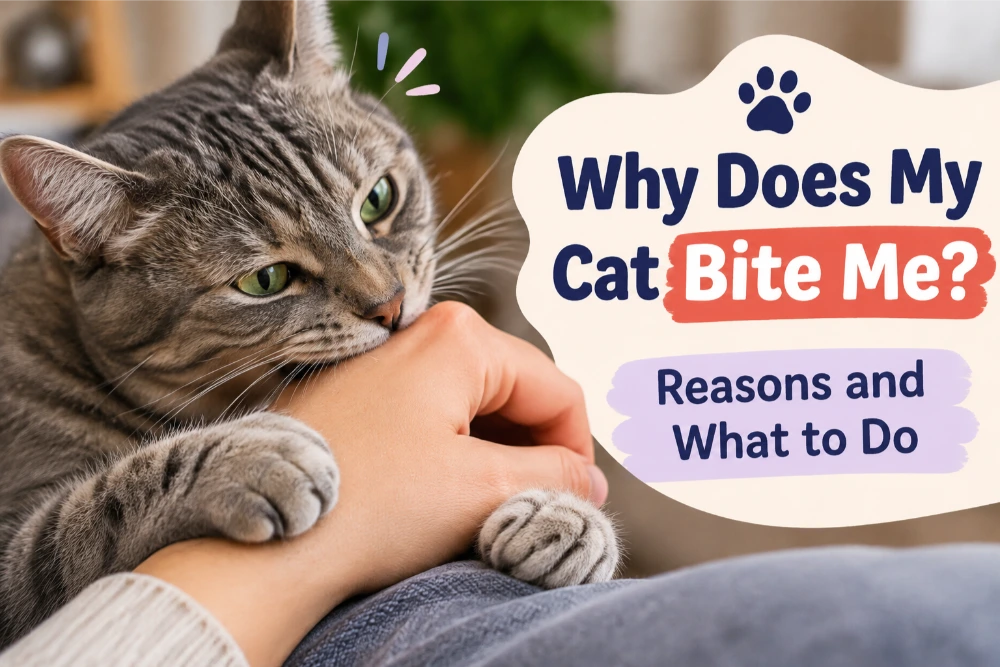
Why Does My Cat Bite Me? Reasons and What to Do
Why does my cat bite me when everything seems calm? You’re stroking your cat, enjoying a peaceful moment, and suddenly, your cat bites you and jumps off your lap. Now you’re left wondering what went wrong.
If that sounds familiar, you’re not alone. Cats bite for many reasons, and most of them make sense once you learn to recognize their behaviour. This guide explains the common reasons cats bite, the warning signs to watch for, how to stop biting, and what to do if your cat bites you.
The quick answer:
Cats bite because of play, too much petting (overstimulation), fear, frustration, pain, or to get your attention. Soft nibbles are often play or affection. Hard bites usually mean fear, pain, or “I have had enough.” Do not punish your cat. Learn the warning signs, redirect biting to toys, and see a vet if the biting is new or sudden.
In this guide:
- What your cat’s bite means (quick table)
- 7 reasons cats bite
- Warning signs before a bite
- How to stop your cat from biting
- What not to do
- When to see a vet
- If your cat bites you: first aid
- Frequently asked questions
What Your Cat’s Bite Means:
Different bites mean different things. Use this table to get a first idea of what your cat is telling you.
| What you see | What it looks like | Most likely reason |
| Soft nibble | Gentle, no pain, often with purring or grooming | Affection or play |
| Pounce and bite | Your cat leaps at moving hands, feet, or ankles | Play or hunting instinct |
| Bite after petting | Your cat turns suddenly, often with a twitching tail | Overstimulation |
| Hard bite with hissing | Flat ears, wide eyes, growling | Fear or self-defense |
| Sudden bite after something upsets them | A noise, or another cat seen outside, then a bite at you | Redirected frustration |
| Bite when touched in one spot | New behavior, flinching, or hiding | Pain or illness |
| Bite to get your attention | Nips at you at meal times or at night | Attention or hunger |
| Chewing fingers (kittens) | Nips at you at meal times or at night | Teething and exploring |
7 Reasons Cats Bite:
1. Play and the hunting instinct
Kittens and young cats often bite while playing. This is sometimes called play aggression, and it copies how they play with their littermates. Cats are natural hunters, and moving hands and feet look like prey. A cat that bites your ankles as you walk past, or pounces on your hand under the blanket, is usually playing, not angry.
What helps: play with your cat every day using toys, so the hunting energy has somewhere to go.

2. Overstimulation from petting
This is one of the most common reasons. Many cats like being petted, up to a point. Cats have very sensitive hair follicles that send touch signals to the brain. After a while, touch stops feeling nice, and your cat may bite to say “enough.” This is sometimes called “don’t pet me” or petting aggression.
It often looks like a cat who is relaxed on your lap and then suddenly turns around and bites. Most cats give warning signs first, such as turning their head, swishing their tail, giving a cranky meow, or tensing their muscles. The bite usually comes when those signs are missed.
What helps: pet where your cat likes it, which for most cats is the head and cheeks. Keep sessions short, and stop at the first warning sign.
3. Fear or self-defense
A cat who feels cornered, startled, or threatened may bite to protect herself. Fear bites tend to be harder than play nips, and they often come with hissing, flattened ears, wide eyes, and a crouched body. Understanding your cat’s body language can also help explain why your cat stares at you and what those looks might mean. New people, loud noises, vet visits, and being picked up when they do not want to be are common triggers.
What helps: give a frightened cat space and a safe place to hide. Do not force handling. If your cat is fearful of being touched, ask your vet to refer you to a certified cat behaviorist.
4. Redirected frustration
Sometimes a bite has nothing to do with you. If your cat sees something she cannot reach, such as another cat outside the window, she may be wound up and take it out on whoever is closest. This is called redirected aggression. It can be sudden and scary, and the person bitten often has no idea what happened.
What helps: give a worked-up cat time to calm down, and do not touch her. Block the view of whatever upset her, for example by closing the blinds. Then let her settle on her own.
5. Pain or illness
A cat who is hurting may bite when touched in a sore spot. Even a small shift during petting can trigger a bite if a joint, limb, neck, or back is painful. If your cat has started biting when she never did before, pain is a real possibility, especially in older cats.
What helps: book a vet visit to rule out pain and illness. This is the first step when a bite is new, sudden, or out of character.
6. Attention, hunger, or affection
Some cats bite to get your attention, for example nipping at your hand or ankles at dinner time, or at night when you are asleep. Vocal behaviour can also reveal what your cat wants, so it’s worth understanding why your cat meows so much. Others give gentle “love bites,” soft nibbles that seem to be a sign of affection and may copy the way cats groom each other. If a bite is gentle and your cat is relaxed, it is usually harmless.
What helps: do not reward demand biting with food or attention. Feed on a schedule, and give attention when your cat is calm. If the nibbles get harder, stop the interaction calmly.
7. Teething and exploring (kittens)
Kittens between about 3 and 6 months may bite and chew to ease teething pain and explore the world. They also learn how hard to bite through rough play with littermates. A kitten raised without littermates may need more help learning gentle play.
What helps: offer chew-safe kitten toys, and never let a kitten play with your hands or feet. That habit is cute at 8 weeks and painful at 8 months.
Warning Signs Before a Bite:
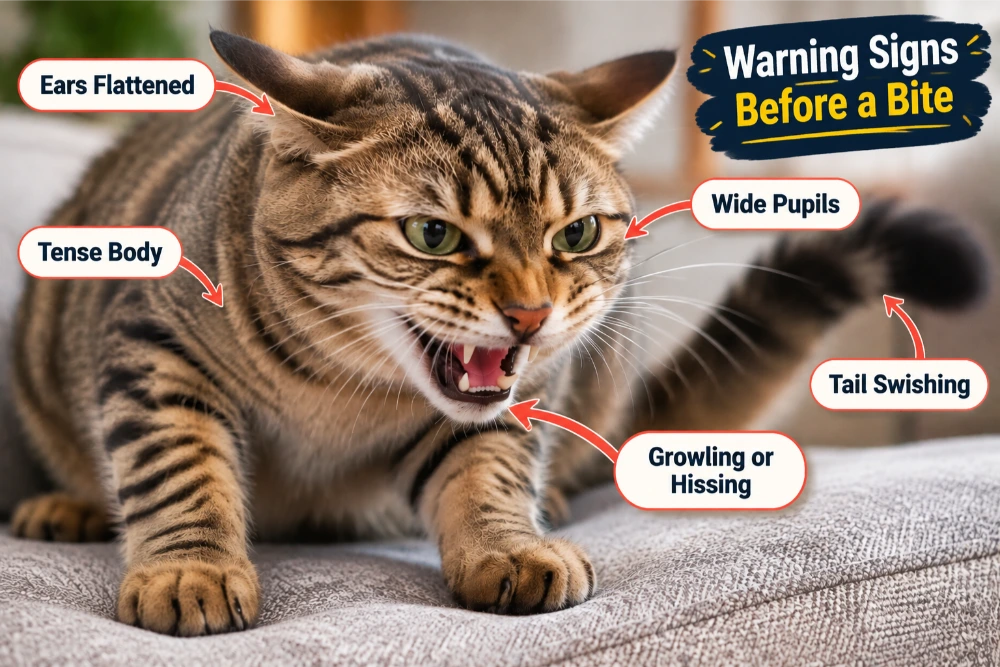
Most cats warn you before they bite. If you learn the signals, you can stop and avoid the bite. Look for:
- A twitching, flicking, or swishing tail. Understanding cat tail meanings can help you recognize when your cat is becoming irritated or uncomfortable.
- Ears turning sideways or flattening
- Skin rippling along the back
- Turning or whipping the head toward your hand
- Tense muscles and a stiff body
- A low growl or a cranky meow
- Wide, dilated pupils
When you see any of these, stop petting and calmly move your hand away. Do not wait for the bite.
How to Stop Your Cat From Biting:
- Learn your cat’s warning signs. Watch what happens just before a bite, and keep track of the pattern.
- Stop and stay calm. If your cat bites, stop the interaction and move away quietly. Do not yell or hit.
- Never use your hands or feet as toys. Use wand toys, feather toys, and other toys that keep your body away from the teeth.
- Play every day. Aim for at least one or two play sessions a day, more often for young, energetic cats. A wand toy lets your cat stalk, chase, and “catch,” which uses up the hunting energy that might otherwise end up on your ankles.
- Pet the right way. Pet the head and cheeks, keep sessions short, and stop before your cat has had enough. Avoid the belly and other sensitive spots unless your cat clearly enjoys it.
- Give other outlets. Scratching posts, cat trees, window perches, and food puzzles help bored cats burn energy.
- Reward calm behavior. Give a treat or a quiet word when your cat stays relaxed while you pet her.
- Get help if it does not improve. If biting is frequent, hard, or comes with fear, see your vet, then ask about a certified cat behaviorist or a veterinary behaviorist.
What Not to Do:
Do not punish your cat. Yelling, hitting, or spraying water does not teach a cat to stop. It makes her afraid, and that can lead to more biting. Veterinary behavior guidance is clear that punishment creates fear.
- Do not use your hands as toys. It teaches your cat that skin is something to bite.
- Do not push through the warning signs. Keep petting a cat who is flicking her tail, and a bite is likely.
- Do not corner or grab a frightened cat. Give her room to escape.
- Do not bite or hit your cat back. She will not understand, and it can damage your bond.
When to See a Vet:
Behavior and health are linked. See your vet if:
- Your cat has suddenly started biting, or bites much harder than before
- She bites when touched in a particular spot, or flinches or limps
- She is also hiding, eating less, or using the litter box differently
- Your cat is older, since pain is a common cause of new aggression in older pets
- The biting is frequent, hard, or breaks the skin
Your vet can check for pain and illness, and can refer you to a behaviorist if needed.
If Your Cat Bites You: First Aid
A cat bite is more serious than it looks. A cat’s sharp teeth make small, deep puncture wounds that seal over quickly. That can trap bacteria from the cat’s mouth under the skin, where it multiplies. An infection can develop within 24 to 48 hours.
- Wash the wound right away. Run it under clean water for at least 5 minutes. Use mild soap. Do not scrub hard, and avoid strong disinfectants, which can harm the skin.
- Cover it with a clean bandage.
- See a doctor, even if the wound looks small. You may need antibiotics. If the cat’s vaccination status is unknown, the doctor may also talk to you about rabies.
- Watch for signs of infection: increasing redness, swelling, warmth, more pain, pus, or a fever. If you notice any of these, see a doctor right away.
We are not doctors. This is general information. For any bite that breaks the skin, ask a doctor or local medical service for advice.
Frequently Asked Questions:
The Bottom Line:
A cat bite is communication. It can mean “let’s play,” “that is enough,” “I am scared,” or “something hurts.” Watch your cat’s body language, stop before the bite, give her plenty of play, and never punish. If the biting is new, sudden, or hard, see your vet first.
This article is for general information. It is not a substitute for advice from your veterinarian or a doctor.
Sources
- VCA Animal Hospitals: Cat Behavior Problems: Petting Aggression, vcahospitals.com
- VCA Animal Hospitals: Cat Bite Injuries to Humans, vcahospitals.com
- Dr. Mikel Delgado, certified applied animal behaviorist, quoted in Rover: Why Is My Cat Biting Me?, rover.com
- International Cat Care and Cornell Feline Health Center: feline behavior resources