Best Cat Scratching Posts
The Best Cat Scratching Posts at a glance: if you only buy one, buy the SmartCat Ultimate Scratching Post (approx $60). At 32 inches tall, most adult cats can stretch fully against it, and its woven sisal and wide base fix the two reasons cats reject posts: too short, and wobbles when they lean in. Large cats do better with the 41-inch MidWest Feline Nuvo Grand Forte (approx $60). Short on money? The Frisco 21-in Sisal Scratching Post costs approx $15. Short on floor space? The CatastrophiCreations Wall-Mounted Sisal Pole (approx $156+) uses none.
A scratching post is not optional furniture. Scratching is a need — if you do not give your cat a good place to do it, they will choose one themselves, and it will probably be your sofa. Most “my cat won’t use the post” problems are really “the post is too short, too wobbly, or in the wrong place” problems. This guide explains what to look for, compares the materials, and gives five picks for most homes and budgets.
Prices below are approximate US prices checked in November 2026. They change often — check the current price before you buy.
In this guide
- Why do cats scratch?
- What makes a scratching post cats actually use?
- Scratching materials compared: sisal, carpet and cardboard
- The 5 best cat scratching posts
- Where to put a scratching post
- How to get your cat to use a new post
- Frequently asked questions
Why Do Cats Scratch?
Scratching looks destructive, but it is normal, healthy behaviour:
- Territory marking. Cats have scent glands between their toes, so scratching leaves a visible mark and a scent mark that says “this is mine”. It is one of several ways cats communicate — their tails do a lot of the talking too, as our guide to cat tail meanings explains.
- Claw maintenance. Scratching strips off the dead outer sheath of the claw, keeping the sharp new claw underneath in good shape — closer to a manicure than to sharpening a knife.
- Stretching. A good scratch is a full-body stretch of the shoulders, back and legs — which is why cats often scratch right after a nap.
- Stress relief and excitement. Many cats scratch when happy, excited or frustrated. A scratch when you come home is often a greeting, not a crime.
You cannot train scratching away — and should not try. What you can do is give it a better target than your furniture.
What Makes a Scratching Post Cats Actually Use?
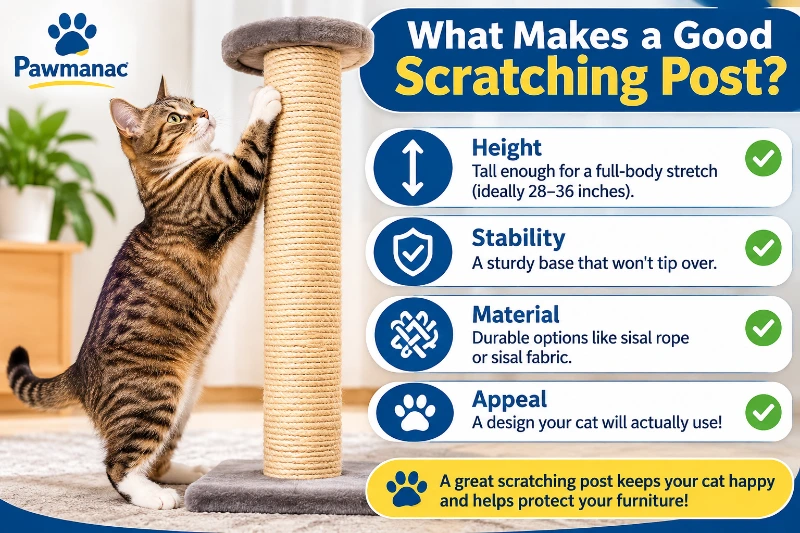
Height: at least 28–32 inches
This is the spec most people get wrong. To scratch properly, a cat stands on its hind legs and stretches its whole body up the post — that needs at least 28–32 inches for an average adult cat. Anything much shorter gets ignored, and a cat that cannot stretch on the post will stretch on the door frame instead. Large breeds such as Maine Coons need 36 inches and up.
Stability: it must not wobble
Cats lean their full weight into a scratch. If the post rocks or tips even once, many cats will not trust it again. Look for a wide, heavy base (16 inches square or more) and a solid core — weight matters more than looks.
Material: something that shreds a little
Cats like a surface their claws can catch and pull through, leaving marks behind. Sisal is the most popular for a reason (see the table below). Avoid loose carpet loops that can catch and trap a claw.
One post is a start, not a finish
Most homes do better with two: one near where the cat sleeps, one near the furniture being scratched. If your cat is big or still growing, plan for a taller second post — or a full cat tree, like the ones in our guide to the best cat trees for large cats.
Scratching Materials Compared

| Material | How it feels to scratch | Durability | Watch out for |
|---|---|---|---|
| Sisal rope | Rough, grippy; claws catch between the wraps | High — the longest-lasting common option | Cheap wrapping can unravel if the ends are not secured |
| Sisal fabric (woven) | Even, consistent surface with no gaps | High — wears evenly, no rope ends to pull loose | Eventually wears through in the one spot your cat favours |
| Carpet | Soft and familiar — sometimes too familiar | Medium | Loops can snag and trap a claw; it also teaches cats that carpet (including yours) is a scratch surface |
| Cardboard | Soft shredding that many cats love | Low — it is designed to be destroyed | Sheds bits everywhere and needs replacing, though refills are cheap |
In short: sisal rope or fabric for a long-lasting vertical post; cardboard if your cat prefers scratching flat or at an angle. Many cats like one of each.
The 5 Best Cat Scratching Posts
| Pick | Best for | Height | Material | Approx price |
|---|---|---|---|---|
| SmartCat Ultimate Scratching Post | Best overall | 32 in | Sisal fabric | $60 |
| MidWest Feline Nuvo Grand Forte | Large cats | 41 in | Sisal rope | $60 |
| PetFusion 3-Sided Vertical Scratcher | Cardboard fans | 16 in (21 in large) | Cardboard | $40–50 |
| Frisco 21-in Sisal Scratching Post with Toy | Best budget | 21 in | Sisal rope | $15 |
| CatastrophiCreations Wall-Mounted Sisal Pole | Small spaces | Mounts at your height | Sisal rope | $156+ |
1. SmartCat Ultimate Scratching Post — best overall
Who it’s for: most households with an average-size adult cat. Height: 32 inches. Material: woven sisal fabric over a solid core, on a 16 × 16 inch base. Approx price: $60.
This is the post to beat. At 32 inches it clears the full-stretch test most posts fail, the woven sisal gives an even surface with no rope ends to unravel, and the wide base keeps it planted when a cat leans in. Assembly is two screws. It is a plain, neutral post — no perches, no toys, nothing you do not need.
Honest downside: you are paying for height and build, not extras, and heavy scratchers will eventually wear the sisal through in their favourite band — at which point it needs re-wrapping or replacing rather than a cheap refill.
2. MidWest Feline Nuvo Grand Forte — best for large cats
Who it’s for: Maine Coons, big mixed breeds, heavy cats and multi-cat homes. Height: 41 inches. Material: thick sisal rope, on a 19 × 19 inch base. Approx price: $60.
Most posts top out at 32 inches — not enough for a large cat to stretch fully. This one is 41 inches, with an oversized base and enough weight (around 19–23 lbs) to stay put when a 15 lb cat throws itself at it. If your cat has already tipped a standard post over, this is the upgrade.
Honest downside: it is big and heavy with a real footprint, and the faux-fur base is itself a scratch surface to some cats. Prices vary a lot between sellers, so shop around.
3. PetFusion 3-Sided Vertical Scratcher — best cardboard option
Who it’s for: cats that prefer cardboard, kittens, and anyone who wants to test what their cat likes before spending more. Height: about 16 inches (standard) or 21 inches (large). Material: recycled corrugated cardboard in a triangular design. Approx price: $40–50 for the standard size.
The triangle gives three scratching faces at different angles, so it suits cats that scratch vertically, at a slant, or in between — and cats can climb and perch on it too. It comes with organic catnip to get things started, and the cardboard is recyclable.
Honest downside: at 16 inches the standard size is too short for a full upright stretch, so treat it as a second scratcher, not your only post. Cardboard is also a consumable: expect shredded bits on the floor and a replacement in months, not years.
4. Frisco 21-in Sisal Scratching Post with Toy — best budget
Who it’s for: kittens, small cats, second-post duty next to a problem sofa, and tight budgets. Height: 21 inches. Material: sisal rope, with a hanging pom-pom toy. Approx price: $15 (a two-pack is often around $26).
For the price of a pizza, you get a real sisal post that fits in a corner and works well as a “scratch this instead” decoy beside the furniture your cat is attacking. At this price, buying two and covering two rooms is sensible.
Honest downside: 21 inches is too short for most adult cats to stretch fully, and the light base can shift or tip with a big cat. Think of it as a starter or spare, not the main post.
5. CatastrophiCreations Wall-Mounted Sisal Pole — best for small spaces
Who it’s for: small apartments, renters with a landlord who allows screws (see the downside), and anyone building a wall-mounted cat highway. Height: you choose — the pole mounts to a single wall stud and comes in tiered sections, so it can run far taller than any floor post. Material: sisal rope on bamboo and steel hardware. Approx price: $156 and up, depending on configuration.
Wall mounting solves two classic problems at once: zero floor space, and zero wobble, because the pole is fixed to a stud. Sections are replaceable when the sisal wears (approx $33 a segment), which makes it cheaper to maintain over years than it first looks.
Honest downside: it is the most expensive option here by a wide margin, and it is a DIY job — you need a wall stud and a drill, so it is not suitable for every rental. A buy-it-for-years piece, not a first scratcher.
Where to Put a Scratching Post
Placement matters as much as the post itself — a perfect post in the wrong room will be ignored.
- Next to the nap spot. Cats love a stretch-and-scratch on waking — put a post beside the bed or chair where your cat sleeps.
- Beside the furniture under attack. If the sofa arm is the target, the post goes right next to that arm, not across the room. Once the post is the habit, inch it to a better spot over a week or two.
- In the social centre, not in exile. Cats mark territory where life happens. A post hidden in a spare room is a post that will not be used — living room beats laundry room.
- Near doorways and entrances. Classic marking spots; a post nearby catches the behaviour.
- One per key area in multi-cat homes. Cats that share everything else may not want to share a marking post.
How to Get Your Cat to Use a New Post
- Put it where the scratching already happens, even if that is the middle of the room. Location first, tidiness later.
- Make it smell interesting. Rub catnip into the sisal, or hang a favourite toy from the top so your cat reaches up the post to bat at it — reaching up is halfway to scratching.
- Scratch it yourself. Drag your fingernails down the post in front of your cat. It sounds silly; it works surprisingly often.
- Reward, never punish. Praise and a treat when claws touch the post. If you catch scratching on the sofa, calmly lift your cat to the post instead — shouting just teaches your cat to scratch when you are out. (If redirection regularly ends in swatting or biting, our guide to why your cat bites you covers what is going on.)
- Protect the furniture while the habit forms. Double-sided deterrent tape or a washable throw over the favourite sofa spot makes the post the most attractive option by comparison.
- Give it time. Some cats take to a post in a day; others need two or three weeks.
Frequently Asked Questions
The Bottom Line
Cats scratch to mark territory, maintain their claws and stretch — you are choosing where it happens, not whether. Choose tall (32 inches or more), stable, and sisal: the SmartCat Ultimate for most homes, the MidWest Grand Forte for large cats, cardboard or the budget Frisco as a second scratcher, and a wall-mounted pole if floor space is the problem. Put it where your cat already scratches, and the sofa usually survives.
This article is for general information. Prices were checked in November 2026 and change often — confirm the current price before buying.